
TL;DR
Listen free for 30 days with Audible
Thousands of audiobooks and originals — cancel anytime.
Start your free trialAs an affiliate, we earn on qualifying purchases.
Pendulum clocks keep time through the steady swing of a weighted pendulum, governed by the physics of harmonic motion. Advances in material science and design have improved their accuracy, but their core principle remains simple yet elegant.
Imagine a weight suspended from a thin rod, swinging back and forth with a rhythmic certainty that can last for centuries. That simple motion forms the heart of the pendulum clock — a marvel of 17th-century engineering that transformed how humanity keeps track of time. Today, we’ll uncover how that swinging weight controls each second, why it’s such a clever system, and what recent tweaks have made it even better.
If you’ve ever admired a vintage clock or wondered why a pendulum swings at a predictable interval, this guide reveals the secret sauce behind one of history’s most enduring timekeeping inventions. We’ll explore the physics, the mechanics, and the innovations that keep these clocks ticking accurately for generations.
The period of a pendulum depends only on its length and gravity, making it naturally reliable for timekeeping.
The escapement mechanism converts the pendulum’s swing into controlled gear movements, driving the clock’s hands.
Small swing angles and stable materials help maintain accuracy over long periods.
Environmental factors like temperature and location influence the pendulum’s precision, but clever design minimizes these effects.
Though largely replaced by digital timekeeping, pendulum clocks remain symbols of engineering elegance and educational value.
How Pendulum Clocks Keep Time
TL;DR: Pendulum clocks keep time through the steady swing of a weighted pendulum, governed by harmonic motion. The escapement turns each swing into controlled gear movement, while careful materials and calibration keep the rhythm accurate for generations.
The secret is not the weight. It is the length.
The period of a pendulum depends mainly on its length and local gravity, making it a naturally stable mechanical timekeeper.
Small swings keep the period nearly constant.
A precision clock can stay within a few seconds per day.
Period rises with length and falls with gravity.
Christiaan Huygens transformed mechanical timekeeping.
Many household clocks use a near one-second rhythm.
Short arcs reduce timing error from amplitude.
Temperature changes alter pendulum length.
The Physics Behind the Swing
A pendulum is a suspended weight that trades height for speed and back again. When the swing angle stays small, that motion repeats with remarkable regularity, which is exactly what a clock needs.
Longer means slower
A longer pendulum takes more time to complete each swing. A shorter pendulum swings faster, like a higher musical note.
Gravity sets the pull
Gravity restores the bob toward center. Slight changes in local gravity can make a clock run a little fast or slow.
Weight is not the timer
The bob needs enough mass to swing steadily, but its mass does not determine the period for small oscillations.
What Controls the Period?
From Swing to Ticking Hands
The pendulum alone only swings. The escapement makes it useful: it gives the pendulum tiny timed impulses and allows the gear train to advance one controlled step at a time.
Power
A weight or spring stores energy for the mechanism.
Gear Train
Gears try to unwind the stored energy continuously.
Escapement
A pallet releases the gear in tiny steps.
Pendulum
The swing regulates when each step is allowed.
Hands
The dial advances in synchronized seconds and minutes.
| Component | What It Does | Timekeeping Impact | Risk If Poorly Tuned |
|---|---|---|---|
| Pendulum | Provides the repeating period. | ✓ Stable rhythm | ~ Runs fast or slow |
| Escapement | Controls gear release and gives impulses. | ✓ Converts swing into ticks | ✗ Irregular ticking |
| Gear Train | Transfers motion to the hands. | ✓ Scales seconds to minutes | ~ Wear and friction |
| Weight or Spring | Supplies energy lost to friction and air. | ✓ Sustains motion | ✗ Clock stops |
Why Precision Is Hard
The ideal pendulum lives in a clean physics equation. The real one lives in changing rooms, aging bearings, moving air, and a planet where gravity varies by location.
Keep the swing small, the length stable, and the friction low.
Clockmakers fight drift by reducing amplitude error, compensating for thermal expansion, polishing contact surfaces, and shielding the mechanism from vibration and drafts.
Accuracy Checklist
Less than five degrees keeps harmonic motion close to ideal.
Gridiron pendulums use metals that expand differently to stabilize length.
Synthetic jewels and precision pivots reduce wear and energy loss.
Altitude and latitude slightly change gravity, so fine clocks need adjustment.
What Makes a Clock Drift?
A pendulum clock is a physical instrument, so its accuracy depends on the environment as much as the mechanism.
Adjust the bob
Raising the bob shortens the effective pendulum and speeds the clock. Lowering it lengthens the pendulum and slows the clock.
Shield the swing
Stable placement, level mounting, and a calm room help the pendulum keep a clean, repeatable arc.
Old Principle, Smarter Materials
Modern timekeeping has moved to quartz and atomic standards, but pendulum clock design still shows how clever mechanics can tame real-world physics.
| Timekeeper | Regulating Element | Strength | Everyday Role Today |
|---|---|---|---|
| Pendulum Clock | Swinging bob and rod | ✓ Visible mechanical elegance | Decorative, educational, historical |
| Quartz Clock | Vibrating quartz crystal | ✓ Cheap and very accurate | Common household timekeeping |
| Atomic Clock | Atomic frequency standard | ✓ Extreme precision | Science, navigation, global time |
| Hybrid Pendulum | Mechanical display plus electronics | ~ Stability with visual charm | Specialty clocks and displays |
Does a heavier bob keep better time?
Not by itself. For small swings, period depends on length and gravity, not mass. A suitable bob can help maintain momentum, but it is not the timing variable.
Why do long pendulums swing slowly?
A longer rod gives the bob a longer path and a slower natural period. That is why clockmakers tune time by changing pendulum length.
What does the escapement actually do?
It acts as both gate and helper: it releases the gear train in steps and returns small impulses to keep the pendulum moving.
Are pendulum clocks still useful?
They are mostly decorative and educational now, but they remain superb demonstrations of harmonic motion, gravity, and mechanical design.
The Traceable Time Chain
A pendulum clock works because every part has a job in one linked loop: stored energy becomes regulated motion, regulated motion becomes ticks, and ticks become readable time.
Energy
Weight or spring stores usable force.
Gears
Train transfers force through ratios.
Escape
Mechanism releases motion in steps.
Pendulum
Length and gravity regulate period.
Tick
Each beat advances the count.
Dial
Hands translate beats into time.
Why the Swing of a Pendulum Is the Key to Keeping Time
The secret to a pendulum clock’s accuracy lies in the reliable rhythm of its swing. When a weight swings from side to side, it follows a natural harmonic motion, which means it swings back and forth at a consistent interval. This interval, or period, depends mainly on the length of the pendulum and gravity.
For example, a typical household pendulum with a length of about 1 meter swings back and forth once every second. That’s because the formula for the period — T = 2π √(L/g) — shows the period increases with length and decreases with gravity. It’s almost like a musical note: longer pendulums produce lower pitches, and shorter ones swing faster.

Hicarer Quartz Clock Mechanism with Pendulum, 2 Pairs Hands Replacement
- Complete clock repair set: Includes hands, pendulum, and instructions
- Pendulum clock mechanism size: Approx. 23mm shaft length, suitable for 9-13mm panels
- Jump second movement: Precise second hand for accurate timekeeping
As an affiliate, we earn on qualifying purchases.
As an affiliate, we earn on qualifying purchases.
How the Clock Turns Swinging Into Moving Hands
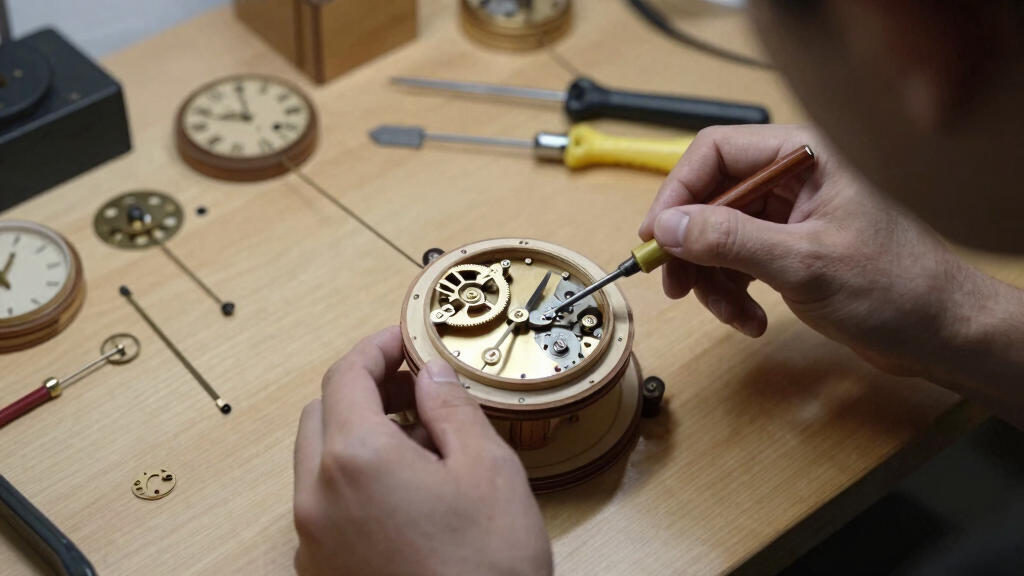
The steady swing alone doesn’t tell time — it’s how we control and amplify that motion that makes a clock tick. The key component is the escapement mechanism. Think of it as a gatekeeper that allows the gear train to advance in tiny, controlled steps each time the pendulum swings.
For instance, in a classic verge escapement, a swinging pallet interacts with a gear wheel, releasing it little by little. This process converts the pendulum’s rhythmic swing into the ticking of the clock’s gears, moving the minute and hour hands forward at a steady rate. It’s like turning a continuous wave into a series of precise steps.

Youngtown 12888 Pendulum Type Step Movement 9/10" Shaft Battery Replacement
- Suitable for clock repair and making: Ideal for repairing or creating clocks
- Multiple models available: Check dimensions before purchase
- Versatile application: Suitable for embroidery, crafts, and clocks
As an affiliate, we earn on qualifying purchases.
As an affiliate, we earn on qualifying purchases.
The Physics of the Perfect Swing — What Makes It Reliable?
Imagine trying to keep a child’s swing moving with just a gentle push — if you push at the right moment, it keeps swinging longer. The same idea applies to pendulums. The closer the swing is to a small angle, the more consistent its period.
That’s why many pendulum clocks are designed with small swing angles, typically less than 5 degrees. Larger swings introduce variations because the pendulum spends more time at the extremes, which can throw off the timing. The physics here is simple: keep the swing small, and the motion stays predictable.

Hicarer Quartz Pendulum Clock Movement Westminster Chime, 3 Pairs Hands
- Complete clock movement set: Includes hands, pendulum, chime, hardware
- Size and compatibility: 17mm shaft, fits 2-6mm thick panels
- Hand dimensions: Various lengths for hour, minute, second hands
As an affiliate, we earn on qualifying purchases.
As an affiliate, we earn on qualifying purchases.
Recent Improvements That Make Pendulum Clocks More Accurate
Over the centuries, engineers have tinkered with pendulum clocks to boost their precision. One breakthrough was the gridiron pendulum, which uses alternating metal rods with different coefficients of thermal expansion. As temperatures fluctuate, the length stays stable, keeping the swing period steady.
Another innovation involves using low-friction materials, like synthetic jewels, in the escapement to reduce wear and energy loss. These tweaks can improve accuracy from a few seconds off per day to just a few seconds per week.
While atomic clocks now keep time with incredible precision, these mechanical marvels still charm collectors and educators alike, reminding us of human ingenuity.
Youngtown 12888 Pendulum Type Step Movement 9/10" Shaft Battery Replacement
- Suitable for clock repair and making: Ideal for repairing or creating clocks
- Multiple models available: Check dimensions before purchase
- Versatile application: Suitable for embroidery, crafts, and clocks
As an affiliate, we earn on qualifying purchases.
As an affiliate, we earn on qualifying purchases.
What Really Affects How Well a Pendulum Keeps Time?
Many factors can throw off a pendulum’s rhythm. Temperature changes make the metal expand or contract, slightly altering the length and the swing period. Even a small breeze can dampen the swing, especially in ornate, open-frame clocks.
Location also matters. Variations in gravity — like moving from sea level to the mountains — affect the swing. A clock on the top of a mountain might run a fraction faster because gravity is slightly weaker there.
Knowing these quirks helps clockmakers fine-tune their creations. For example, adjusting the length of the pendulum compensates for temperature swings, keeping the time ticking just right.
Is a Pendulum Clock Still Useful Today? Here’s Why It Matters
Most modern clocks are electronic or digital, but pendulum clocks carry a special charm. They’re not just decorative; they teach us about the physics of motion and time. Plus, their craftsmanship makes them prized heirlooms or conversation pieces.
In classrooms, they serve as excellent teaching tools for understanding harmonic motion and gravity. Some high-end homes and museums still display accurate, beautifully crafted pendulum clocks as symbols of engineering history.
Despite their limitations in accuracy compared to atomic clocks, pendulum clocks remind us of a time when mechanical ingenuity ruled the world of timekeeping.
Quick Guide: How to Make a Pendulum Swing Perfectly
- Choose a weight (bob) and a string or rod. Keep it smooth and sturdy.
- Set the length carefully — for a one-second period, roughly 1 meter is ideal.
- Pull the weight back just a few degrees (less than 5°).
- Release gently, letting it swing freely without pushing.
- Observe and fine-tune the length if needed, to match the desired swing period.
Tip: Keep the swing in a place shielded from wind and vibrations for best results.
Frequently Asked Questions
How does the length of the pendulum affect its swing?
The longer the pendulum, the slower it swings — meaning a longer period. Shorter pendulums swing faster, with a shorter period. This relationship is captured in the formula T = 2π√(L/g).Why do pendulum clocks become inaccurate over time?
Factors like temperature fluctuations, wear in the escapement, and slight changes in local gravity can alter the pendulum’s period. Proper calibration and temperature compensation help maintain accuracy.Are pendulum clocks still used today?
Most are decorative or educational, as modern digital and atomic clocks are far more precise. However, pendulum clocks remain valued for their craftsmanship, beauty, and historical significance.How does gravity influence a pendulum clock?
Gravity affects the pendulum’s swing; at higher altitudes or different locations on Earth, gravity varies slightly, which can make the clock run a little faster or slower. Designers often compensate for this in high-precision clocks.What makes the escapement so critical?
The escapement controls the release of energy from the clock’s power source and ensures the gear train advances in precise steps synchronized with the pendulum’s swing. Without it, the clock would run erratically.Conclusion
When you watch a pendulum swing, you’re witnessing a simple act of physics turned into art. Its steady rhythm isn’t just about keeping time — it’s a testament to human craftsmanship and understanding of nature’s laws. Even in a digital age, that graceful swing continues to inspire admiration and curiosity.
Next time you see a vintage clock or hear the rhythmic tick-tock of a pendulum, remember: it’s not just a clock. It’s a tiny, swinging miracle built on the timeless harmony between gravity and motion.
Fall Picks
fall essentials
As an affiliate, we earn on qualifying purchases.