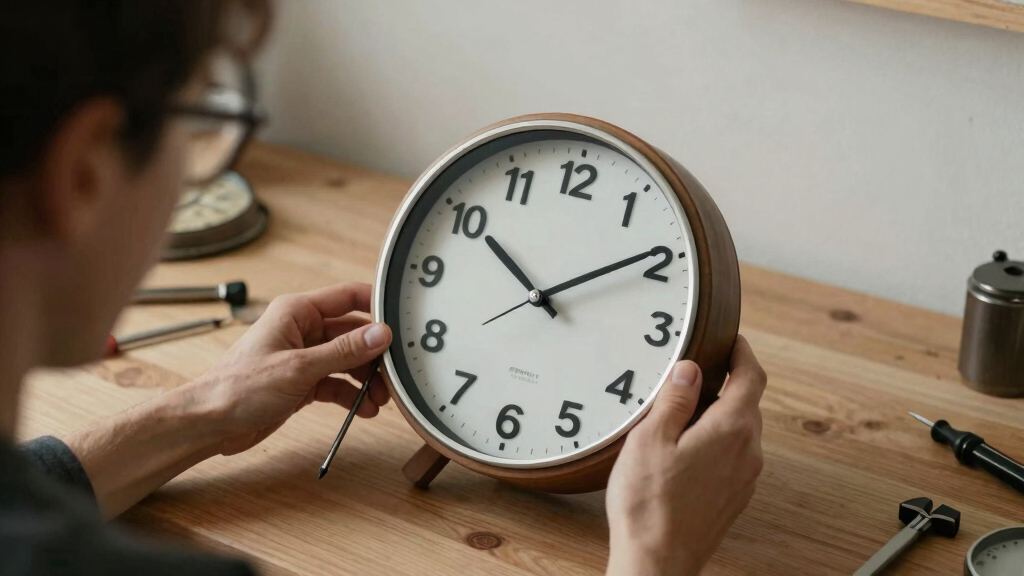

TL;DR

Get decor and gifts delivered free with Prime
- Fast, free delivery on millions of items
- Prime Video, Amazon Music and more included
- Member-only deals all year
Clocks run clockwise because their design traces back to sundials in the Northern Hemisphere, where shadows moved in that direction. This pattern was adopted in mechanical clocks and became a global standard, influencing how we see time visually.
Ever wonder why the hands on your clock turn in a circle that seems almost natural? It’s no accident. The familiar clockwise movement traces its roots to ancient sundials, where shadows moved in a specific direction due to the sun’s path. This simple observation shaped centuries of timekeeping design.
In this guide, you’ll learn why clocks run clockwise, how cultural influences spread this way of telling time, and what makes the round clock face so universally recognizable. It’s a fascinating story about the intersection of nature, history, and human ingenuity.
The direction of clocks—clockwise—originates from the shadow movement on ancient sundials in the Northern Hemisphere.
European medieval clocks mimicked these shadows, leading to the widespread adoption of clockwise movement.
Despite cultural variations, the clockwise pattern became a global standard due to influence and practicality.
The circular clock face and continuous hand movement are designed for ease of reading and natural cycle representation.
Novelty clocks challenge tradition, but the clockwise pattern remains deeply ingrained in our perception of time.
How Ancient Sundials Set the Pattern for Clocks
The journey begins with ancient Egyptian and Greek sundials. These devices used the sun’s position to tell time, casting shadows that moved in a predictable direction. In the Northern Hemisphere, shadows tip westward in the morning, then sweep around to the east as the sun arcs overhead, finally settling west at sunset.
Early Europeans noticed this pattern. When they created mechanical clocks in the 14th century, they mimicked this shadow movement, giving us the familiar clockwise direction. It’s like a mirror of the sun’s journey across the sky, captured in metal and gears.
analog wall clock with large numbers
As an affiliate, we earn on qualifying purchases.
As an affiliate, we earn on qualifying purchases.
Why ‘Clockwise’ Is Named After the Movement
The phrase ‘clockwise’ comes directly from these early mechanical clocks. Since most clocks in medieval Europe followed the same movement as sundial shadows, the term naturally emerged to describe that specific direction. It’s a simple, intuitive label rooted in visual similarity.
Imagine a clock face with 12 at the top. The hands moving from 12 to 1, then 2, and so on—this mirrors the sun’s apparent path in the sky. That’s why the term ‘clockwise’ stuck and became a universal standard across cultures that adopted similar timekeeping methods.
As an affiliate, we earn on qualifying purchases.
Northern Hemisphere Bias Shapes Clock Design
The dominant influence on clock direction comes from the sun’s path in the Northern Hemisphere. Here, shadows cast by sundials naturally move clockwise as the sun arcs from east to west.
In the Southern Hemisphere, the shadow movement on sundials appears to go counterclockwise when viewed from the same perspective. Yet, most clocks worldwide stick to the clockwise standard, because European cultures and later technological developments dictated this norm.
For example, in Australia or South Africa, sundials might seem to run backwards, but the familiar clock face remains the same, reinforcing the global standardization of clockwise movement.
modern round clock for living room
As an affiliate, we earn on qualifying purchases.
As an affiliate, we earn on qualifying purchases.
Design Choices That Made Clocks Universal
Once the standard was set in Europe, it spread worldwide through colonization, trade, and technological sharing. The circular face, with its 12-hour division, became a natural way to represent the day. The continuous motion of the hands fits perfectly with our perception of time as a cycle.
Over centuries, this design has been refined but kept its core: a circle with moving hands. Today, digital clocks may not have a direction, but the visual cue of clockwise movement remains ingrained in our minds.
As an affiliate, we earn on qualifying purchases.
Can Clocks Run Counterclockwise? Yes, But It’s Rare
Clocks can technically run counterclockwise. Some novelty and artistic clocks challenge tradition for aesthetic or humorous reasons. For example, you might see a clock with the hands moving from 12 to 11, then 10, in reverse.
However, these are exceptions. For most people, a clock running counterclockwise feels strange and less intuitive. It’s like trying to read a language with reversed grammar—it works, but it’s unfamiliar.
In fact, some cultures or historical periods have experimented with different directions, but the standard has always leaned toward clockwise in the West.
Why Is the Clock Face Round? The Power of Simplicity
The round shape isn’t just aesthetic. It’s about continuous movement and ease of reading. The circular form allows the hands to sweep smoothly around, covering the 360 degrees of a clock face.
Imagine trying to tell time on a square or irregular shape—less intuitive, less elegant. The circle also mirrors the sun’s shape, reinforcing the connection to natural cycles.
Plus, a round face makes it easier to design gears and mechanisms that rotate seamlessly, ensuring accuracy and durability.
What About Other Cultures and Their Timekeeping?
Historically, different cultures used varied methods to track time. Some ancient Chinese and Islamic clocks had distinct conventions, but European influence largely standardized the 12-hour, clockwise clock face we see today.
Today, digital clocks and global tech have reinforced the clockwise pattern. Still, it’s fascinating that in some eras and places, the conventions were different, reminding us that timekeeping is as much cultural as it is scientific.
What Does This Mean for How We Perceive Time?
Our perception of time is deeply tied to the visual cues we see every day. The clockwise movement feels natural because it aligns with our brain’s expectations, shaped by centuries of sundial shadows and mechanical clocks.
When you glance at a clock, that familiar sweep from 12 to 1, then 2, reinforces our sense of a continuous, predictable flow of time. Change that pattern, and it might feel unsettling or confusing.
So, the design isn’t just aesthetic—it influences how we experience and understand time itself.
Quick Summary: Why Clocks Run Clockwise
The short answer? Clocks run clockwise because early sundials in the Northern Hemisphere cast shadows that moved in that direction. When mechanical clocks emerged, they mimicked this natural pattern, which then became the global standard.
This design aligns with our perception of time’s flow and the natural cycle of the sun. Despite some variations, the clockwise movement remains the universal symbol of how we measure hours.
Frequently Asked Questions
Why do sundials in the Southern Hemisphere seem to run backwards?
Because the sun’s path in the Southern Hemisphere causes shadows to move in the opposite direction when viewed from the same perspective. However, most clocks follow the Northern Hemisphere standard, which is why they seem reversed to some.Can clocks be made to run counterclockwise?
Yes, but it’s rare. Some novelty clocks are intentionally designed to run counterclockwise for artistic or humorous effect. Still, it’s not practical for everyday use, as it confuses our natural perception of time.Why are most clock faces round?
Because a circle allows for continuous, smooth movement of the hands and visually mirrors the sun’s shape. It also makes gear mechanisms simpler and easier to manufacture, ensuring accurate timekeeping.Did other cultures use different clock directions?
In history, some cultures had different ways of tracking time, but European influence standardized the 12-hour, clockwise clock face we recognize today. Variations still exist in traditional or artistic clocks.Why do we use 12-hour and 24-hour systems?
These systems come from ancient civilizations, especially Egypt and Rome, based on astronomical observations and practical division of the day. The 12-hour cycle stems from the number of lunar cycles or parts of the day in many ancient cultures.Conclusion
Next time you glance at a clock, remember it’s more than just a pretty face. Its clockwise movement is a mirror of the sun’s journey, shaped by centuries of observation and cultural influence. That simple, elegant circle encodes a story of human ingenuity and our connection to the natural world.
Whether digital or analog, the clockwise sweep continues to reflect our shared history and perception of time—an unbroken dance between the sky and our clocks.
Halloween Picks
halloween
As an affiliate, we earn on qualifying purchases.