TL;DR

Get decor and gifts delivered free with Prime
- Fast, free delivery on millions of items
- Prime Video, Amazon Music and more included
- Member-only deals all year
Word clocks use tiny LEDs, precision stencils, and diffusers to create clear, customizable displays. Modern manufacturing balances design, efficiency, and durability, making these clocks both beautiful and long-lasting.
Precision in stencil cutting ensures LEDs are perfectly aligned, directly impacting light uniformity and overall look.
Diffusers are vital for spreading LED light evenly, transforming hotspots into a soft, consistent glow.
Choosing the right materials (frosted acrylic, high-quality stencils) balances cost, durability, and visual quality.
Modern manufacturing combines traditional craftsmanship with advanced tools like laser cutters for perfect accuracy.
Innovations like RGB LEDs and smart controls are expanding what’s possible in personalized, high-tech word clocks.
How Word Clocks Are Made: LEDs, Stencils, and Diffusers
Word clocks turn electronics into typography. Tiny LEDs create the light, precision stencils keep every letter aligned, and diffusers transform harsh points into a smooth readable glow.
Uniform light is the hidden craft behind a word clock that feels polished instead of patchy.
The three layers that make the words glow.
Manufacturing quality comes from balancing brightness, alignment, and softness. Each layer has a different job, but the clock only works beautifully when all three line up.
Tiny light engines
SMD LEDs fit behind compact word grids, use little power, produce low heat, and can be dimmed or color controlled by a microcontroller.
Precision masks
Plastic or metal stencils guide placement so each LED sits exactly behind its intended word, reducing blur, waste, and rework.
Soft optical finish
Frosted acrylic or polycarbonate spreads each LED point into an even glow, improving readability and reducing harsh hotspots.
Step by step: from grid to finished clock.
The craft is half electronics, half visual design. A clean build sequence keeps the final words crisp, bright, and reliable.
Design layout
Choose words like IT, IS, FIVE, TEN, PAST, and TO, then arrange them in a readable grid.
Cut stencil
Laser-cut or mill a mask that matches the word grid and guides exact LED placement.
Mount LEDs
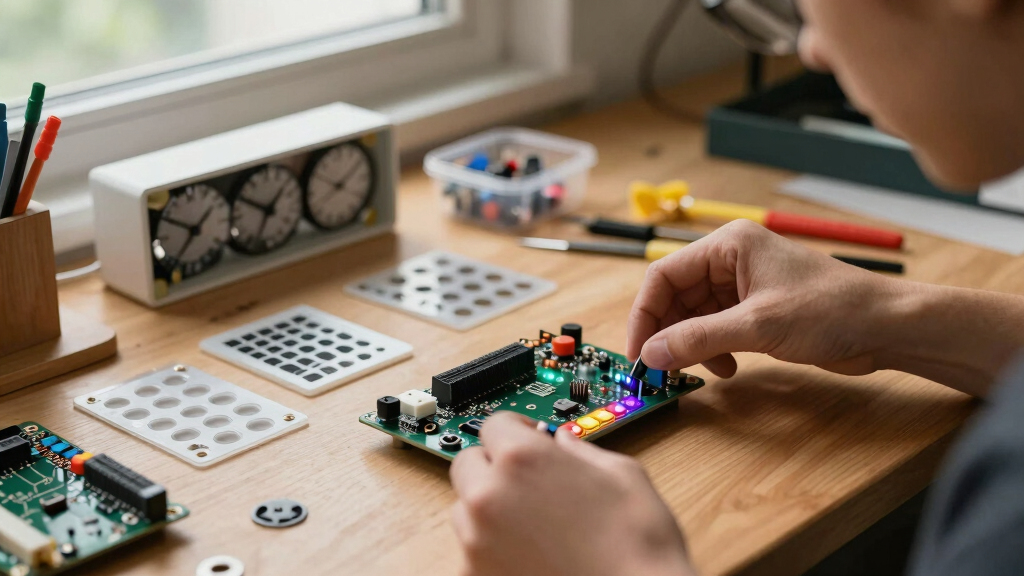
Solder surface-mount LEDs onto a PCB connected to power and control circuitry.
Add diffuser
Place frosted material over the light grid to blend point sources into smooth illumination.
Assemble case
Enclose the stack, connect power, and program the microcontroller to display time.
Materials that make or break the glow.
Premium parts cost more upfront, but they improve uniformity, durability, and the amount of post-assembly correction needed.
| Feature | Material Options | Best Contribution | Tradeoff | Build Signal |
|---|---|---|---|---|
| LEDs | SMD LEDs, RGB LEDs | ✓ Bright, efficient, long-lasting | ~ Wiring and control complexity rise with large arrays | Choose for size, brightness, color control, and thermal performance. |
| Stencils | Plastic, metal | ✓ Accurate LED alignment and repeatable assembly | ✗ Custom precision masks can be expensive | Use when crisp words and consistent production matter. |
| Diffusers | Frosted acrylic, polycarbonate | ✓ Fewer hotspots and softer readability | ~ Too much scattering can reduce brightness | Balance thickness, opacity, brightness, and viewing distance. |
Where precision has the biggest payoff.
The most visible improvements come from even diffusion and precise placement, because both directly shape what the viewer sees first.
Diffusion balance
Thin diffusion can leave hotspots. Heavy diffusion looks soft but may waste brightness. The sweet spot creates readable words without glare.
Traceability: every design decision shows up in the face.
A word clock is a stack of dependencies. Good layout choices only become visible when electronics, masks, optics, and software stay aligned.
What Are LEDs and Why Are They Perfect for Word Clocks?
LEDs, or light-emitting diodes, are small, energy-efficient, and incredibly bright sources of light. They’re perfect for word clocks because they can be placed in tight spaces and still produce a clear, crisp glow. A typical word clock uses tiny surface-mount LEDs (SMD LEDs) that can be as small as 1mm across.
Imagine a grid of 60 or more LEDs behind a clock face—each one precisely positioned to light up specific words like ‘IT’, ‘IS’, or ‘FIVE’. The brightness can be adjusted, and many LEDs last tens of thousands of hours. For example, a well-made word clock might run for over 50,000 hours before needing a replacement—think of it as a decade of glow without worries.
Choosing LEDs for this purpose is a strategic decision. Their efficiency means less heat, which extends their lifespan and maintains consistent brightness. Their small size allows for intricate designs without bulky components, enabling sleek, modern aesthetics. However, tradeoffs include the need for precise control circuitry and potential complexity in wiring when dealing with large arrays. This balance of size, efficiency, and control complexity is why LEDs are considered ideal yet require thoughtful integration.
As an affiliate, we earn on qualifying purchases.
How Tiny Stencils Keep Everything in Its Place
Stencils are key to lining up LEDs perfectly behind the clock face. Think of them as detailed masks—cut from plastic or metal—that define where each LED sits. During manufacturing, these stencils are placed over the circuit boards to ensure each LED is mounted in exactly the right spot.
Picture a stencil with dozens of tiny holes, each corresponding to a word or part of a word. When the LEDs are soldered through these holes, the stencil is removed, leaving perfectly aligned LEDs. This precision is crucial—any misalignment can cause uneven lighting or blurry words.
For example, in a high-end word clock, the stencil might be milled to 0.1mm accuracy, ensuring each LED shines exactly through its designated area. Without this, the final product might look uneven or less polished. The importance of such precision extends beyond aesthetics—misaligned LEDs can lead to uneven brightness, which impacts readability and perceived quality. The tradeoff here is that highly accurate stencils can be costly and require advanced manufacturing equipment, but their role in ensuring a professional, uniform appearance justifies the investment. Accurate placement minimizes the need for post-assembly adjustments, streamlining production and reducing waste, ultimately improving the reliability and visual consistency of the final product.
As an affiliate, we earn on qualifying purchases.
Diffusers Turn Hotspots Into Even Glow
Diffusers are translucent materials placed over or around LEDs to spread light evenly. Without them, LEDs create bright spots—hotspots—that make the words look uneven or harsh. Think of diffusers as the frosted glass in a bathroom light fixture, softening the glow.
Common diffuser materials include frosted acrylic or polycarbonate sheets. They’re cut to fit over the LED grid, spreading light in all directions. This ensures every letter or word appears uniformly luminous, even when the LEDs are very close together.
For instance, a diffuser might be 3mm thick frosted acrylic that, when placed over a 5mm LED, distributes light smoothly across the word clock face. The importance of diffusers goes beyond just aesthetic appeal; they directly influence the clock’s readability and reduce eye strain by providing a gentle, consistent illumination. Poor diffusion can cause glare or uneven brightness, making it harder to read the time at a glance. The tradeoffs involve balancing brightness and diffusion—thicker or more scattering diffusers may reduce overall brightness but improve uniformity. Selecting the right diffuser material and thickness is a critical design decision that impacts both visual quality and energy efficiency, ensuring the clock is both beautiful and practical to use over many years.
As an affiliate, we earn on qualifying purchases.
Step-by-Step: How a Word Clock Comes Together
- Design the layout: Decide which words will form the time display, then create a grid.
- Create the stencil: Precisely cut the mask to match the layout, ensuring perfect alignment.
- Mount the LEDs: Place the LEDs into the stencil’s holes and solder them onto the circuit board.
- Apply diffusers: Attach or insert diffuser sheets to spread the LED light evenly.
- Assemble the case: House everything in a stylish enclosure, connect power, and program the microcontroller.
For example, a DIY enthusiast might start with a simple layout on paper, then move to laser-cut a stencil, solder LEDs onto a custom PCB, and finish with a frosted acrylic diffuser—transforming raw parts into a glowing timepiece. Each step requires careful planning—improper alignment or choosing incompatible materials can compromise the final appearance and function. The precision in each phase ensures that the glow is uniform, the words are crisp, and the clock operates reliably over time. Investing time in understanding these details can make the difference between a mediocre project and a professional-quality masterpiece.
As an affiliate, we earn on qualifying purchases.
Comparison: Materials That Make or Break Your Word Clock
| Feature | Material Options | Pros | Cons |
|---|---|---|---|
| LEDs | SMD LEDs, RGB LEDs | Bright, energy-efficient, long-lasting | Cost varies, some require complicated wiring |
| Stencils | Plastic, metal | Precise, reusable | Costly if custom-made |
| Diffusers | Frosted acrylic, polycarbonate | Uniform glow, reduces hotspots | Can diffuse too much, reducing brightness |
Choosing the right materials involves understanding their impact on the final product. For instance, high-quality stencils ensure precise LED placement, which reduces rework and material waste, ultimately saving costs. Diffuser materials influence the softness and uniformity of the glow—using a subpar diffuser can result in uneven lighting that distracts from the clock’s sleek appearance. The tradeoff is often between cost and quality—premium materials may cost more initially but lead to a more durable, visually appealing clock with less maintenance or adjustment needed over time. Material choices also affect manufacturing speed; easier-to-handle materials can streamline assembly, but might compromise on precision or diffusion quality. Balancing these factors is essential to produce a reliable, beautiful, and cost-effective product.
Why Precision and Quality Matter in Manufacturing
High-quality stencil cutting and careful diffuser placement make a difference. A tiny misalignment can cause uneven lighting, distracting from the clock’s sleek look. Precision tools like laser cutters and CNC machines help achieve the tight tolerances needed.
For instance, a small variance of 0.05mm in stencil cuts can mean the difference between crisp, clear words and blurry, uneven ones. The best manufacturers invest in these details to ensure every clock looks professional and functions perfectly. This precision directly impacts the lifespan of the product—misalignments can cause stress points that lead to early component failure. Furthermore, meticulous quality control reduces the need for rework, saving costs and ensuring consistency across production batches. The implication is clear: investing in high-precision manufacturing processes results in a product that not only looks better but also performs reliably over many years, reinforcing brand reputation and customer satisfaction.
What’s Next? Innovations in Word Clock Making
Recent advances include customizable colors with RGB LEDs and smart features like Wi-Fi control. Some clocks now use micro-LEDs that are even smaller, allowing for thinner designs. Eco-friendly materials are also gaining ground, reducing environmental impact.
Imagine a clock that changes colors based on your mood or syncs with your smart home system. As technology evolves, so does the artistry behind making these glowing timepieces. These innovations are not just about aesthetics—they also focus on energy efficiency, ease of customization, and integration with modern tech ecosystems. The tradeoffs involve balancing complexity with user-friendliness and cost, but the overall impact is a more versatile and personalized product. The future of word clocks lies in smart, sustainable, and highly customizable designs that cater to individual preferences while maintaining high standards of craftsmanship and efficiency.
Frequently Asked Questions
How do LEDs stay so bright while using so little power?
LEDs are highly efficient light sources that convert most electricity directly into visible light. Thanks to advances in semiconductor technology, they last longer and consume less energy—sometimes as little as 1/10th the power of incandescent bulbs.Can I make my own word clock at home?
Yes. With some basic electronics skills, a DIY kit, and patience, you can assemble a word clock. You’ll need a microcontroller, LEDs, a stencil, and a diffuser. Plenty of tutorials are available online to guide you step-by-step.What’s the best diffuser material for even lighting?
Frosted acrylic or polycarbonate are popular choices. They scatter light efficiently, creating a smooth, even glow without hotspots. The thickness and texture can be adjusted depending on how diffuse you want the light to be.How long do the LEDs in a word clock last?
Most LEDs have a lifespan of over 50,000 hours—that’s more than 5 years of continuous use. Proper heat management and quality components further extend their durability.Are color-changing or programmable clocks worth it?
Absolutely. RGB LEDs and programmable chips let you customize colors, brightness, and effects. They add a fun, dynamic element and are perfect for matching your decor or mood shifts.Conclusion
Creating a stunning word clock is all about the details—tiny LEDs, precise stencils, and well-placed diffusers. These elements work together to turn simple components into a luminous piece of art. When you admire a glowing word clock, you’re also appreciating the craftsmanship behind each glowing letter.Halloween Picks
halloween
As an affiliate, we earn on qualifying purchases.