
TL;DR
Listen free for 30 days with Audible
Thousands of audiobooks and originals — cancel anytime.
Start your free trialAs an affiliate, we earn on qualifying purchases.
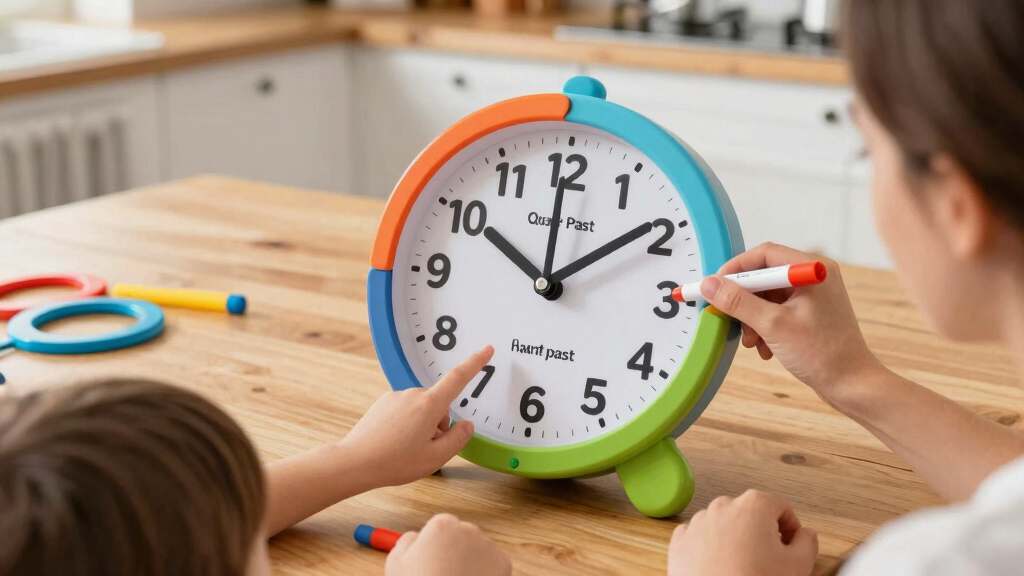
Teaching kids clock language like ‘quarter past’ and ‘quarter to’ is easiest when you connect these terms to the clock’s visual cues and real-world examples. Using hands-on tools and simple math helps children understand how the clock divides the hour into meaningful segments.
Ever tried explaining ‘quarter past’ or ‘quarter to’ and watched your child’s face glaze over? It’s a common challenge. These phrases sound simple, but they pack a lot of meaning for little brains just starting to read clocks.
In this guide, you’ll learn how to turn those confusing terms into clear, visual stories kids understand. Whether you’re helping a five-year-old grasp their first clock or a slightly older child sharpening their skills, the goal is to make time-telling fun, not frustrating.
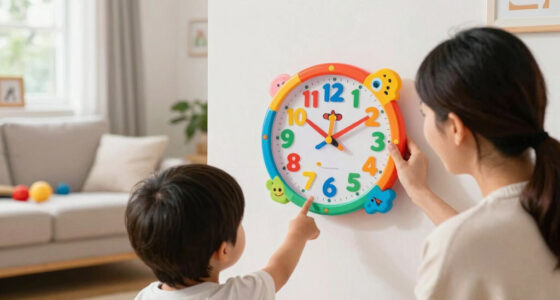
Use vivid visuals and physical clocks to help kids see what ‘quarter past’ and ‘quarter to’ really mean.
Connect clock phrases to real-life routines to make the language stick better.
Practice with fun games and stories that involve moving clock hands or identifying times.
Remember that ‘quarter’ equals 15 minutes and ‘half’ equals 30 minutes—these are the building blocks.
Incorporate digital tools and multisensory activities to deepen understanding and engagement.
What does ‘quarter past,’ ‘half past,’ and ‘quarter to’ really mean?
‘Quarter past’ means 15 minutes after the hour. Imagine the minute hand moving a quarter of the way around the clock from the 12, which highlights the significance of dividing the hour into four equal parts — each representing 15 minutes. Understanding this helps children grasp that time segments are uniform and predictable, making it easier to estimate or calculate time quickly. ‘Half past’ is 30 minutes after the hour, with the minute hand pointing directly at 6, which visually demonstrates the halfway point of the clock face. ‘Quarter to’ indicates 15 minutes before the next hour, with the minute hand approaching 12 from the 9, emphasizing the concept of counting down to the next hour. Recognizing these segments as parts of a whole fosters a deeper comprehension of how clocks are divided and why these terms are meaningful, rather than just arbitrary phrases.
For example, at 3:15, the clock shows ‘quarter past three,’ which signals that a quarter of the hour has elapsed since 3:00. At 3:30, it’s ‘half past three,’ indicating the middle of the hour. When the clock hits 3:45, or a quarter to four, the minute hand is at 9, counting down those last 15 minutes to the next hour. This understanding allows children to anticipate upcoming times and develop mental math skills related to time intervals, which are essential for daily planning and time management.
Understanding these segments also helps children develop a sense of rhythm and flow in time, much like music. This awareness makes it easier for them to grasp the concept of passing time and anticipate upcoming events, which is crucial for developing punctuality and time awareness. Recognizing the importance of these segments also encourages children to think critically about how time is structured, fostering a foundational understanding that extends beyond telling time to broader skills like planning and time management.
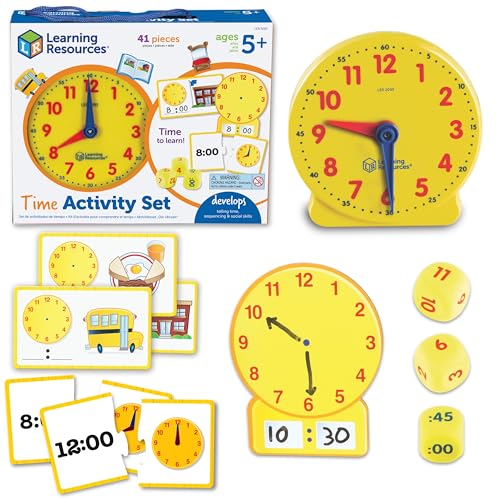
Learning Resources Time Activity Set
- Hands-On Time Learning: Realistic analog clock with moving hands
- Build Time-Telling Skills: Helps identify hours and half-hours
- Ideal for Students & Classrooms: Supports independent and guided learning
As an affiliate, we earn on qualifying purchases.
As an affiliate, we earn on qualifying purchases.
How to teach ‘quarter past’ and ‘quarter to’ with real clocks
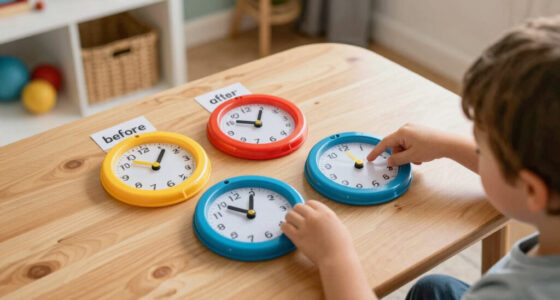
- Show a physical clock with movable hands, set it to different times, like 2:15, 2:45, or 3:30, and discuss how the positions of the hands reflect these specific times. Explain that these physical demonstrations help children see the direct link between how the clock looks and what time it represents, reinforcing the idea that clock reading is a visual skill rooted in understanding the movement of the hands.
- Point out the position of the minute hand at 3, 9, and 12, explaining how these relate to ‘quarter’ and ‘half.’ Emphasize that the minute hand at 3 or 9 marks quarter hours, while at 6 marks the half-hour point, which helps children grasp the significance of these key positions as landmarks for telling time.
- Use everyday scenarios: ‘If it’s 3:15, we’ve been waiting 15 minutes after 3,’ or ‘In 15 minutes, it’ll be 4 o’clock, so it’s a quarter to four.’ These contextual cues help children connect the abstract clock face to real-world activities, making the concept more relevant and memorable. Recognizing these terms in practical situations helps children develop a sense of how time relates to their daily routines, fostering better planning skills and understanding of punctuality.
- Encourage your child to move the hands themselves, reinforcing their understanding through hands-on play. This kinaesthetic approach helps solidify the connection between the physical position of the clock hands and the corresponding time, fostering confidence and independence in reading clocks.
This approach makes the abstract terms concrete, helping kids visualize what each phrase really means on the clock face, and underscores why understanding these segments is vital for everyday time management and punctuality. When children physically manipulate the clock hands, they internalize the movement patterns and develop a more intuitive grasp of how times are represented, which enhances their overall clock literacy and confidence in reading different times accurately.

Learning Resources Big Time Mini Clock
- Hands-on learning clock: Teaches early time skills
- Hidden gears: Maintain correct time when spinning
- Color-coded hands: Match hour and minute markings
As an affiliate, we earn on qualifying purchases.
As an affiliate, we earn on qualifying purchases.
Comparison: ‘Quarter Past’ vs. ‘Quarter To’ — When to use each
| Term | Meaning | Typical Time | Clock Position |
|---|---|---|---|
| Quarter Past | 15 minutes after the hour, indicating that a quarter of the current hour has elapsed. Recognizing this helps children understand the passage of time within the hour and how to interpret time quickly in daily conversations or schedules. | e.g., 2:15 | Minute hand at 3, hour hand slightly past 2, showing a quarter hour has passed since 2:00. |
| Quarter To | 15 minutes before the next hour, emphasizing the countdown to the upcoming hour. This concept is crucial because it teaches children to anticipate upcoming times and understand the structure of the clock face in reverse, which is essential for accurate time estimation and planning. | e.g., 2:45 | Minute hand at 9, hour hand approaching 3, indicating the last quarter before the next hour. |
| Half Past | 30 minutes after the hour, marking the midpoint of the hour, which helps children see the clock face as divided into halves, aiding in mental math and quick recognition of time. | e.g., 2:30 | Minute hand at 6, hour hand midway between 2 and 3, visually representing the halfway point. |
Understanding these differences and their implications allows children to read the clock more intuitively and confidently. It helps them grasp the logical structure of time, enhances their ability to tell time quickly, and prepares them for more complex time concepts in the future. Recognizing when to use each phrase also supports better communication about time in social and educational settings, reducing frustration and increasing accuracy in everyday interactions. This understanding fosters flexibility in language and thinking, allowing children to adapt their time-telling skills to various contexts and improving their overall time literacy.
Learning Resources Time Activity Set
- Hands-On Time Learning: Realistic analog clock with moving hands
- Build Time-Telling Skills: Helps identify hours and half-hours
- Ideal for Students & Classrooms: Supports independent and guided learning
As an affiliate, we earn on qualifying purchases.
As an affiliate, we earn on qualifying purchases.
How to turn clock language into a fun game
- Play ‘Time Detective’ where kids find times like 3:15 or 4:45 on a real clock or digital display. Emphasize the importance of recognizing key positions and understanding what they represent, which builds both visual recognition and critical thinking skills.
- Use flashcards with different times and ask your child to tell if it’s ‘quarter past,’ ‘half past,’ or ‘quarter to.’ Emphasize that this game enhances their ability to quickly identify these key segments, fostering confidence and fluency.
- Create a story around the clock: ‘It’s 2:15, and the big hand just moved to the quarter mark,’ highlighting the narrative aspect helps children internalize the concept as part of a bigger understanding of daily routines and the flow of time.
- Sing songs that incorporate the time phrases, like ‘It’s quarter past, it’s half past, tell the time and have a blast!’ Songs make the learning process memorable and enjoyable, reinforcing the language in a fun, rhythmic way that appeals to children’s natural learning styles.
Making learning playful transforms confusion into curiosity and helps kids remember these terms naturally. When children engage with these activities, they develop a deeper understanding of how clock times are structured and how to quickly identify key moments, which improves their overall confidence and fluency in telling time. The interactive nature of games also encourages social learning and discussion, making the process more engaging and less intimidating for young learners.

Yunbaoit Rainbow Visual Timer for Kids, 60-min Countdown Timer, Blue
- Visual Rainbow Timer: Disappears counterclockwise as time passes
- Easy to Adjust: Turn center knob to set desired time
- Mute and Alert Options: No ticking, with adjustable volume and alarm duration
As an affiliate, we earn on qualifying purchases.
As an affiliate, we earn on qualifying purchases.
Connecting clock language to everyday life
Kids pick up better when they see these terms in their daily routines. For instance, ‘It’s quarter past breakfast time’ or ‘We leave in half an hour.’ These cues serve as practical anchors, helping children understand that clock language isn’t just abstract but directly relates to their daily activities. Recognizing these phrases in context helps them develop a sense of time’s passage, which is essential for punctuality and time management skills that will serve them well throughout life.
Using regular references makes the abstract terms more concrete, enabling children to internalize the meaning behind the phrases. This contextual learning reduces confusion, builds confidence, and fosters a natural understanding of how time influences daily routines. When children see these concepts as part of their personal experiences, they become more adept at estimating and managing their time, leading to better organizational skills and less stress about daily schedules.
Recent trends in teaching clock language
Interactive apps and digital clocks are transforming how children learn to tell time. Many educational tools now incorporate gamified lessons that not only make understanding ‘quarter past’ and similar terms more engaging but also foster deeper conceptual understanding. These tools often include immediate feedback, adaptive difficulty levels, and visual cues that help children see the connection between the clock face and the language used to describe it. This approach supports diverse learning styles and encourages exploration, making clock education more inclusive and effective.
There’s a notable shift from rote memorization towards focusing on the *concept* of time, aided by multisensory activities such as moving physical clock hands, tactile models, and visual storytelling. These methods help solidify understanding by engaging multiple senses, which is especially beneficial for children who learn best through hands-on experiences. Incorporating cultural variations—such as how different languages and cultures describe these times—bresents an opportunity to broaden children’s understanding of global time-telling practices. This cultural awareness fosters respect for diversity and cognitive flexibility, helping children appreciate that time-telling isn’t universal but varies across cultures, enriching their global perspective and understanding of time as a social construct.
Frequently Asked Questions
At what age should my child start learning these clock terms?
Most children begin to grasp ‘quarter past’ and similar phrases around age 5 to 7, depending on their cognitive development and exposure to clocks. Using visual aids early on makes the learning smoother.How can I help my child understand ‘quarter to’ when the minute hand approaches 12?
Explain that ‘quarter to’ means 15 minutes remaining until the next hour. Show how the minute hand at 9 indicates 45 minutes past, so it’s a quarter before the next hour. Hands-on clock activities reinforce this idea and help children visualize the countdown, which is essential for understanding how to anticipate time changes and develop accurate mental models of clock reading.Are there fun ways to teach clock language besides flashcards?
Absolutely! Games like ‘Time Detective,’ storytelling with clocks, singing time songs, or moving physical clocks are all engaging ways to make these concepts stick naturally. These methods foster active learning, which helps children internalize the concepts more deeply than passive memorization.What’s the difference between ‘half past’ and ’30 minutes past’?
‘Half past’ is simply a colloquial way to say 30 minutes after the hour. Both mean the same thing, but ‘half past’ is more conversational and often easier for children to remember because it emphasizes the halfway point of the hour. Recognizing both expressions helps children understand that time can be described in different ways without changing its meaning, which is important for flexible thinking and language comprehension.How do I explain ‘quarter to’ when the clock’s minute hand is near 12?
Clarify that ‘quarter to’ refers to the 15 minutes remaining until the next hour. When the minute hand is at 9, it’s 45 minutes past, which means it’s a quarter to the upcoming hour. Emphasize the counting down of minutes and how the clock’s divisions help visualize this process, making it easier for children to anticipate and understand the transition between hours. This understanding also helps develop an intuitive sense of how time progresses and how to estimate upcoming times accurately.Conclusion
Mastering clock language is about turning abstract terms into tangible, visual stories. When kids see how ‘quarter past’ relates to the clock’s hands and their daily routines, time becomes less mysterious.
Next time you glance at the clock, challenge your child to tell you the time using these familiar phrases. Before long, they’ll read an analog clock as naturally as reading a story—making every minute count.
Flea & tick season Picks
flea and tick prevention
As an affiliate, we earn on qualifying purchases.