
TL;DR

Get decor and gifts delivered free with Prime
- Fast, free delivery on millions of items
- Prime Video, Amazon Music and more included
- Member-only deals all year
This guide offers a detailed lesson sequence for teachers to teach kids how to tell time. It emphasizes hands-on activities, digital tools, and real-world applications, helping students progress from recognizing clock faces to calculating elapsed time.
Imagine a classroom where every child confidently reads the clock—and knows exactly what time it is. Teaching time isn’t just about reading numbers; it’s about helping kids connect with the rhythm of daily life. If you’ve ever watched a student struggle with the hour and minute hands, you know it’s more than just a skill—it’s a gateway to understanding routines, schedules, and even math.
In this article, you’ll get a clear, practical lesson sequence that guides you through teaching kids to tell time. From hands-on activities to digital tools and real-life scenarios, you’ll learn how to turn a potentially confusing topic into an engaging, meaningful experience for your students.
Start with concrete, physical clocks to build foundational understanding.
Use comparison tables and real-life scenarios to connect analog and digital clocks.
Incorporate technology and daily routines to make time-telling practical and memorable.
Assess frequently and tailor activities to support all learners, including those with difficulties.
Progress from basic reading to solving elapsed time problems for a complete skill set.
Start with the Big Picture: Why Telling Time Matters
Teaching time in the classroom sets the foundation for daily routines, independence, and mathematical thinking. Kids as young as 6 can grasp basic concepts, but understanding how to read both analog and digital clocks unlocks a world of practical skills.
Imagine a child planning their day or understanding when their favorite TV show starts—that’s the power of mastering time. According to research by Alphabet Clock, early mastery of time-telling correlates with improved problem-solving and number sense, laying groundwork for future math success.
analog classroom clock with movable hands
As an affiliate, we earn on qualifying purchases.
As an affiliate, we earn on qualifying purchases.
Step 1: Build Concrete Understanding with Real Clocks
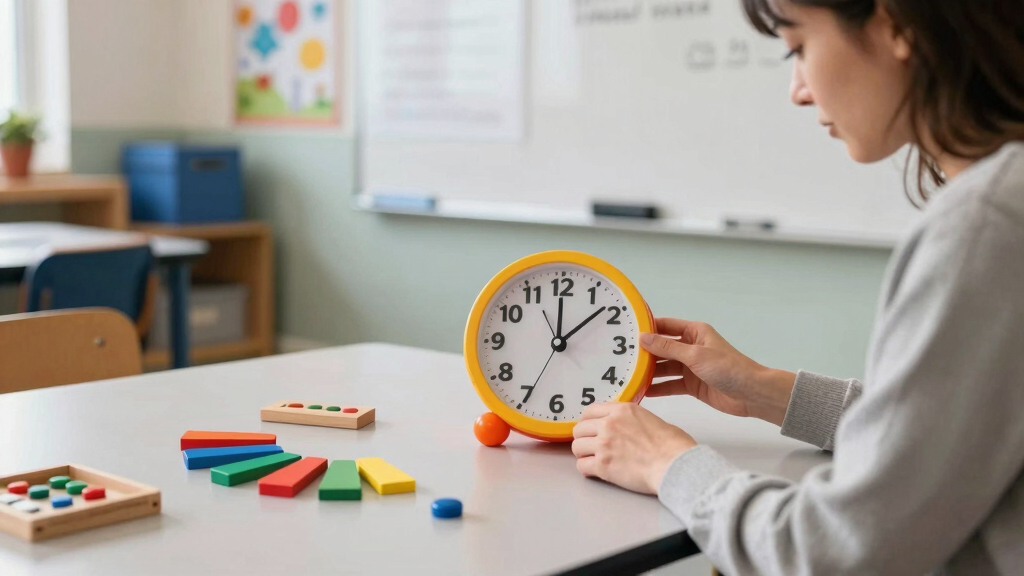
Start with tangible, physical clocks. Use large, colorful analog clocks with movable hands. Have students manipulate the hands to show specific times—like 3:15 or 7:45. This tactile experience not only helps them grasp the mechanics of the clock but also enables them to see the relationship between the position of the hands and the actual time. Understanding this connection is crucial because it anchors abstract concepts in physical experience, making it easier for students to internalize how hours and minutes are represented visually.
This approach allows students to experiment with different times, observe patterns, and develop intuitive reasoning about how the clock works. It also promotes engagement and confidence, especially for learners who benefit from hands-on activities. The tradeoff is that physical clocks may not cover every possible time—so they should be complemented with digital representations later to ensure comprehensive understanding.
As an affiliate, we earn on qualifying purchases.
Step 2: Introduce Digital Clocks and Compare
Once students grasp the analog clock, introduce digital clocks as a complementary way of reading time. Explain that digital clocks display the same information as analog clocks but in a different format—numeric rather than visual. Use side-by-side images or digital timers to highlight differences and similarities. For example, showing 3:15 on a digital display alongside an analog clock with hands at 3 and 15 minutes emphasizes that both formats are just different ways of representing the same moment.
This comparison deepens understanding because students see that the core concept—telling time—is consistent across formats, but the representation varies. It also prepares them for real-world contexts where digital clocks are prevalent. The tradeoff here is that digital clocks can sometimes be confusing when students encounter 12-hour versus 24-hour formats or when they misread leading zeros, so explicit discussion about these nuances is essential.
As an affiliate, we earn on qualifying purchases.
Step 3: Practice Reading and Setting Times
Developing fluency in reading and setting clocks requires repeated, varied practice that builds confidence and flexibility. Create activities where students observe a clock and state the time, then manipulate their own clocks to match it. For example, showing a clock at 10:15 and asking students to set their clocks to the same time helps reinforce both recognition and production skills. Conversely, giving a time and having students read it from a clock promotes decoding skills.
Incorporate different levels of difficulty—simple times like 9:00 for beginners, and more complex times like 12:37 for advanced learners—to ensure all students are challenged appropriately. Regular practice not only improves accuracy but also helps students develop an internal sense of passing time, which is essential for understanding durations and schedules. The key tradeoff is ensuring that practice remains engaging; too many repetitive tasks can lead to boredom, so integrating games or timed challenges can keep motivation high.
As an affiliate, we earn on qualifying purchases.
Step 4: Mastering Elapsed Time and Word Problems
Once students can confidently read clocks, introduce the concept of elapsed time—how to determine the duration between two points in time. This skill is fundamental because it connects clock reading to real-world problem solving and helps students understand the flow of time. By working through word problems such as, “If it’s 2:00 now, what time will it be in 45 minutes?” students learn to add minutes to a given time, a process that requires understanding of both hours and minutes and how they relate.
Using visual aids like number lines, digital timers, or clock diagrams can clarify the passage of time, especially for visual learners. These tools help students see that elapsed time involves counting forward from a starting point, which reinforces their understanding of addition and subtraction in a contextual setting. Mastering this skill opens doors to more complex math topics like schedules, durations, and time management, making it a valuable and practical competency. The challenge is to scaffold problems appropriately—starting simple and gradually increasing complexity—to ensure steady progression and avoid frustration.
Step 5: Incorporate Technology and Real-Life Contexts
Using technology, such as educational apps, online games, and interactive digital clocks, enhances engagement and provides immediate feedback. These tools allow students to practice in a dynamic environment, adapting to their individual pace and offering varied challenges. For example, digital clock quizzes or interactive games on tablets can make practicing time-telling feel like play, reducing anxiety and increasing motivation.
Embedding time skills into daily routines—like reading the clock at the start of class, during transitions, or when checking schedules—helps students see the relevance of what they’re learning. Encouraging them to relate time to their own routines, such as setting alarms or reading bus schedules, fosters practical understanding and personal connection. The tradeoff is that reliance on technology should be balanced with hands-on experiences to develop a well-rounded understanding. Overdependence on screens may limit tactile learning, so integrating both approaches ensures comprehensive development.
Assess and Differentiate to Support Every Learner
Frequent assessment through quizzes, observation, and practical tasks helps identify where students are excelling or struggling. For students who find it difficult to grasp concepts, providing additional manipulatives, simplified clocks, or visual cues can make a significant difference by making abstract ideas more concrete. For advanced learners, introducing concepts like AM/PM, time zones, or calculating durations across days challenges their understanding and promotes higher-order thinking.
Effective differentiation involves adjusting activities based on ongoing assessment. For example, if many students confuse the hour and minute hands, revisit physical clock activities with more explicit cues or introduce digital simulations that reinforce the distinctions. The goal is to tailor instruction so that every student progresses at an appropriate pace, ensuring mastery of foundational skills before moving on to more complex topics. This personalized approach minimizes frustration and maximizes confidence, ultimately leading to greater success in time-telling mastery.
Frequently Asked Questions
What’s the fastest way to help kids learn to tell time?
Use physical, movable clocks paired with daily practice. Make it fun with games and real-life scenarios, and gradually introduce digital clocks once they’re comfortable with analog.How do I teach elapsed time without overwhelming students?
Start with simple scenarios—like how long it takes to walk to the playground. Use visual aids like number lines or timers, and practice regularly to build confidence step-by-step.What if students confuse AM and PM?
Reinforce the difference with routines—like morning and afternoon activities. Use visual cues, like color-coded clocks or story-based explanations, to make the distinction clear.How can I make time lessons more engaging?
Incorporate digital apps, interactive games, and real-world tasks. Let students practice reading clocks during transitions or assign time-related challenges that relate to their daily routines.Are there specific strategies for students with learning differences?
Yes, use multisensory approaches—like tactile clocks, visual aids, and simplified tasks. Extra practice and positive reinforcement help build confidence and mastery.Conclusion
Teaching kids to tell time isn’t just about reading numbers—it’s about helping them understand their world better. A clear, step-by-step approach that combines hands-on activities, tech, and real-life relevance makes the journey engaging and effective.
Remember, patience and practice turn confusion into confidence. When students grasp the flow of time, they gain a rhythm that echoes through their daily lives—and their future learning.
Halloween Picks
halloween
As an affiliate, we earn on qualifying purchases.