
TL;DR

Get decor and gifts delivered free with Prime
- Fast, free delivery on millions of items
- Prime Video, Amazon Music and more included
- Member-only deals all year
Fun Halloween wall clocks range from $15 novelty quartz models to $250+ handmade cuckoo clocks, with styles spanning skeletons, glow-in-the-dark faces, gothic vintage, and kid-friendly designs. The two features that matter most are size (10–14 inches for standard walls, 18–24 for statement pieces) and a silent sweep movement if it’s going anywhere near a bedroom.
Your pumpkin sits on the porch. The wreath is on the door. And yet the living room still feels… like Tuesday. That’s the moment a Halloween wall clock fixes — one swap, and the whole room tips into spooky season.
Halloween décor has become a massive seasonal market — Americans spend over $10 billion a year on the holiday, and home décor is one of the fastest-growing slices of that pie, right behind costumes and candy. But most people stop at pumpkins and throw pillows. A clock does double duty: it decorates and it still tells you when the trick-or-treaters arrive.
In this article, you’ll get the full rundown — the best styles, what sizes actually fit your walls, the silent-movement feature everyone forgets to check, DIY options, and how to style a clock so it anchors a whole vignette instead of floating alone.
Budget $15–$30 for a basic novelty quartz clock, $30–$80 for motion and wood-framed designs, and $80–$250+ for handmade cuckoo clocks — and shop by August, sin…
Match clock size to your wall: 10–14 inches for standard spots, 18–24 inches for statement walls, with the face spanning roughly half the width of the furnitur…
Check for a "silent sweep quartz movement" before buying — a ticking clock will annoy you in any bedroom or dining room.
Style the clock as the anchor of an odd-numbered vignette (clock + wreath + sign) in the entryway or above the mantel instead of hanging it alone.
Gothic and vintage-style clocks work year-round; store seasonal designs in original boxes with batteries removed to prevent corrosion.
Why a Halloween Wall Clock Works Harder Than Any Pumpkin
A Halloween wall clock is functional décor — an item that serves a real purpose while adding ambiance, which is exactly why it beats another plastic pumpkin on the mantel. It fills a wall, tells time, and sets a mood all at once. That’s three jobs for one hook and nail.
Think about your entryway. Guests walk in and their eyes go straight to whatever’s at eye level. A skeleton-hand clock above the console table — bone-shaped hands ticking past a grinning skull — gives them something to actually look at, and something to comment on. Compare that to a scattered collection of small trinkets, which reads as clutter rather than intention.
There’s also the timing angle. Halloween décor now hits shelves in July and August — retailers call it “Summerween” — so the good designs sell out long before the first leaf falls. A clock you buy in August gets nearly three months of display time. A bag of candy corn gets maybe two weeks before you eat it.
A clock is the only Halloween decoration that gets more useful the longer you leave it up.
7 Styles of Halloween Wall Clocks (and Who Each One Is For)
The main categories of fun Halloween wall clocks are character-themed designs, motion clocks, glow-in-the-dark models, gothic vintage styles, retro cat clocks, kid-friendly versions, and sound clocks. Each one suits a different room and a different personality — here’s the honest breakdown.
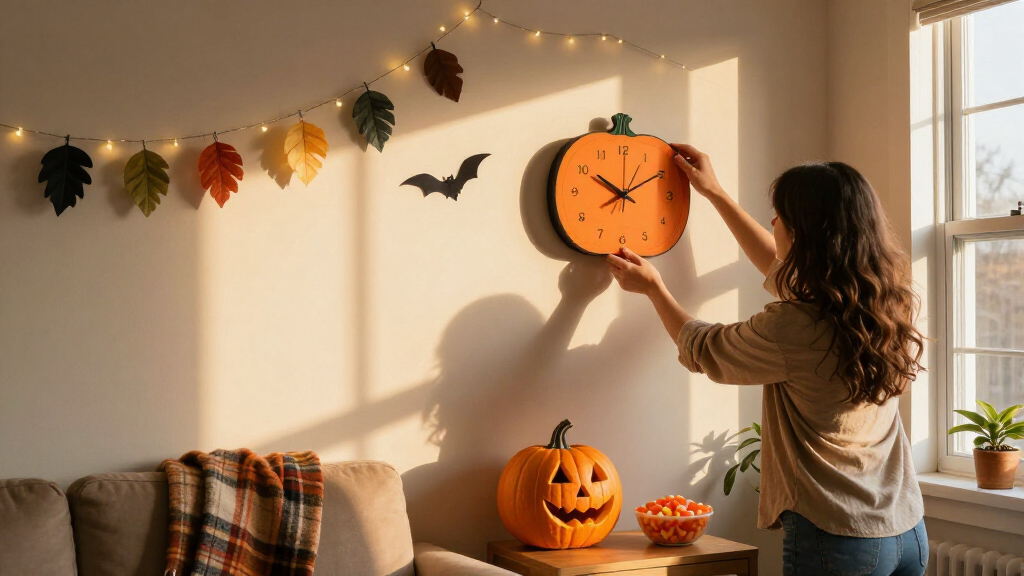
- Character clocks — skeletons, black cats, witches, ghosts, jack-o’-lanterns. Bone-shaped skeleton hands are one of the most popular novelty designs out there. Best for living rooms and entryways.
- Motion clocks — pendulum styles with swinging bats or a witch that rides back and forth. German-made River City Halloween cuckoo clocks are the premium version of this. Great conversation pieces.
- Glow-in-the-dark clocks — faces and hands that charge in daylight and glow at night. Kids adore them; just know the glow fades over a few hours.
- Gothic vintage — Victorian, haunted-mansion, Edgar Allan Poe vibes. These are the ones that stay up year-round in “spooky home” households.
- Retro Kit-Cat style — the famous wagging-tail cat clock in black-and-orange Halloween editions. A perennial favorite and genuinely giftable.
- Kids’ clocks — friendly cartoon ghosts and pumpkins, often doubles as a learn-to-tell-time tool.
- Sound clocks — hourly cackles or spooky chimes. Fun for one night; questionable at 3 a.m.
My neighbor bought a cackling witch clock for her front hall two years ago. By October 15th, the hourly cackle had been silenced permanently — she now describes it as “a learning experience with batteries.”
Halloween wall clocks typically cost $15–$30 for basic quartz novelty models, $30–$80 for motion clocks and better materials, and $80–$250+ for handmade cuckoo clocks and artisan statement pieces. Here’s how the tiers stack up.
| Tier | Price | What You Get | Best For |
|---|---|---|---|
| Budget | $15–$30 | Basic quartz novelty clock, plastic, single print face | Kids’ rooms, offices, one-season fun |
| Mid-range | $30–$80 | Motion elements, wood frames, silent sweep movements | Living rooms, mantels, gifts |
| Premium | $80–$250+ | Handmade cuckoo clocks, licensed horror designs, large artisan pieces | Collectors, year-round spooky homes |
A word on where to shop: Home Goods and TJ Maxx turn up genuinely unique finds at mid-range prices, Target’s Hyde & EEK! line delivers trendy designs cheap, and Etsy is where the personalized name clocks live — think custom teacher gifts with a class theme. Hobby Lobby and Michaels cover the craft-adjacent middle.
Prices and availability shift fast in seasonal décor — check current listings before you commit, because the good stuff rarely gets restocked after September.
3 Features to Check Before You Buy (Most People Miss #2)
The three features that make or break a Halloween wall clock are size, movement noise, and battery access. Get these right and you’ll love the clock; get them wrong and it ends up in the donation box by November.
- Size to your wall. Standard clocks run 10–14 inches; large statement clocks run 18–24 inches. Rule of thumb: the clock face should span roughly half the width of the furniture below it. A 12-inch clock over a 6-foot sofa disappears; an 18-inch one holds its own.
- Silent sweep movement. A ticking clock in a bedroom or dining room gets old fast. Look for “silent sweep quartz movement” in the listing — demand for non-ticking clocks has grown enough that most quality listings now call it out. If they don’t mention it, assume it ticks.
- Battery access. Most run on one AA battery, but decorative models sometimes bury the compartment behind glued-on embellishments. Check the reviews before buying.
The size rule especially matters for glow-in-the-dark models — a 10-inch glowing face reads great in a kid’s room but vanishes on a big living room wall at night.
How to Style a Halloween Clock So It Anchors the Whole Room
The best way to style a Halloween wall clock is to treat it as the anchor of a themed vignette — the piece everything else orbits — rather than letting it float alone on a bare wall. Placement and pairing matter more than the clock itself.
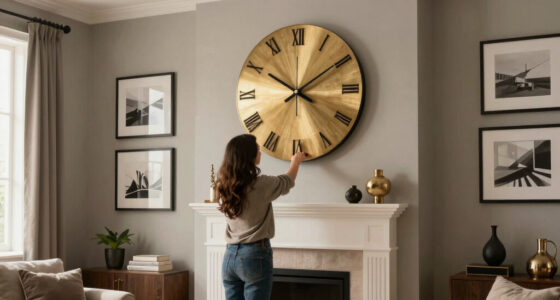
Start with location. An entryway or mudroom placement gives maximum first-impression value, because it’s the first decorated thing guests see. Above the fireplace mantel is the second-best spot — the clock becomes the visual center of your entire Halloween display.
- Build an odd-numbered gallery wall — mix the clock with a wreath, a “Boo” sign, and a small print. Odd numbers (3 or 5 pieces) read as styled; even numbers read as accidental.
- Pair a skeleton clock with texture — apothecary jars, brass candlesticks, a swag of faux cobweb. The hard bone-white hands against soft, layered textures is the whole look.
- Use it under, not just over — a clock centered on a tiered tray display (the farmhouse Halloween crowd loves this) ties the arrangement together.
Picture a mantel like a stage: the clock is the lead actor at center, candlesticks and jars are the supporting cast, and the cobweb is the fog machine. One star, plenty of atmosphere, zero clutter.
DIY a Halloween Clock for $20–$40 (Yes, Really)
You can build your own Halloween wall clock for $20–$40 using a clock movement kit and a decorated base — and craft blogs featuring vinyl decals and paint-your-own kits consistently perform well for a reason. This is one of the easiest seasonal crafts that produces something you’ll actually use.
- Buy a clock kit — a quartz movement with hands runs about $10–$15 online and includes the center shaft and hardware.
- Choose your base — a wood round, an old thrifted clock face, or a painted canvas all work. Sand and paint it your background color (matte black never fails).
- Decorate the face — vinyl decals from a craft cutter, hand-painted numbers, or stenciled spiderwebs. If you want bone hands, paint the kit’s hands white and add knuckle details with a fine brush.
- Assemble and mount — insert the movement through a drilled center hole, attach the hands, add one AA battery, and hang.
One caution: if your DIY version involves any wiring, lighting, or anything beyond a battery movement, stop and either stick with battery power or consult a licensed electrician. Battery quartz kits keep this project firmly in the safe, no-permit zone.
The DIY route also solves the personalization problem. A hand-painted clock with a family name and “Est. 2019” in Halloween lettering is the kind of housewarming gift people actually keep.
Can You Leave It Up Year-Round? (The Gothic Loophole)
Yes — gothic and vintage-style Halloween clocks transition beautifully to year-round décor, which is exactly what the rise of gothic home accounts on TikTok and Instagram has proven. A Victorian-style clock or a muted wood design reads as “moody fall aesthetic” in November and “dark academia” by January.
The styles that don’t work year-round: cartoon pumpkins, glowing jack-o’-lantern faces, and anything with the word “BOO” on it. Those go back in storage — ideally in their original boxes with the batteries removed, since a corroded battery terminal is the number one killer of stored clocks.
The split is simple. Orange-and-black says October; black-and-brass says always. Buy one of each if you’re torn — a neon glow clock for the kids’ room in season, and a gothic piece for the living room that quietly never comes down.
Frequently Asked Questions
Where can I find unique Halloween wall clocks?
Home Goods and TJ Maxx are the best bets for one-of-a-kind mid-range finds, Target’s Hyde & EEK! line has trendy budget options, and Etsy is the go-to for personalized and custom-name clocks. Hobby Lobby and Michaels carry craft-adjacent styles, and River City Clocks makes German Halloween cuckoo clocks at the premium end.
Do glow-in-the-dark Halloween clocks actually work?
Yes, but with limits. The faces and hands need direct light exposure to charge, and the glow typically fades over a few hours after dark. They’re fantastic for kids’ rooms and evening ambiance but won’t stay bright all night.
Are there silent, non-ticking Halloween clocks?
Yes — look for listings that specify a silent sweep quartz movement. Demand for non-ticking clocks has grown enough that most quality listings now state it explicitly. If a listing doesn’t mention it, assume the clock ticks audibly.
How do I store my Halloween clock after the season?
Keep the original box if possible, and always remove the AA battery before storage. Leaked battery acid corroding the terminals is the most common way seasonal clocks die in storage. Store flat in a climate-controlled spot, not a damp garage or attic.
Can I make my own Halloween wall clock?
Absolutely. A quartz clock movement kit costs $10–$15; add a wood round, paint, and vinyl decals or stencils and you’re at $20–$40 total. Stick with battery-powered movements — anything involving wiring or electric lights should be left to a licensed electrician.
Conclusion
If you do one thing after reading this: check the movement before you check the design. A silent sweep clock in the right size will delight you every time you glance at it; a ticking beauty in the wrong size becomes background noise you resent. Get those two features right, and nearly any style you love will work.
Then hang it somewhere people see it — the entryway, the mantel, the wall everyone faces at dinner. Because the best Halloween décor isn’t the loudest; it’s the piece that quietly ticks through the whole season, counting down to the doorbell ringing on October 31st.
Halloween Picks
halloween
As an affiliate, we earn on qualifying purchases.