
TL;DR
Educational wall clocks for kids make the moving parts of time visible: the short hand tracks hours, while the long hand completes a turn every 60 minutes. Choose a clear face with distinct hands and minute markings, then practice in small steps alongside daily routines and digital time.
At 7:40, your child is hunting for one missing sock while you point to the clock and say, “We leave in ten minutes.” The numbers on a digital display may tell them the time, but an analog face lets them see the minute hand moving toward the next number. That small difference can turn a rushed morning into a useful conversation.

Give the gift of listening to the book lover on your list
- Choose a 1-, 3-, 6- or 12-month membership
- They pick the audiobooks they love
- Easy to send by email
Educational wall clocks for kids give young learners a visible way to connect numbers, routines, and the passage of time. The right clock can support practice with counting by fives and time vocabulary, but it won’t teach by itself. You’ll find out what makes a face easy to read, how to match it to your child’s stage, and how to make short practice moments feel like part of family life rather than a test.
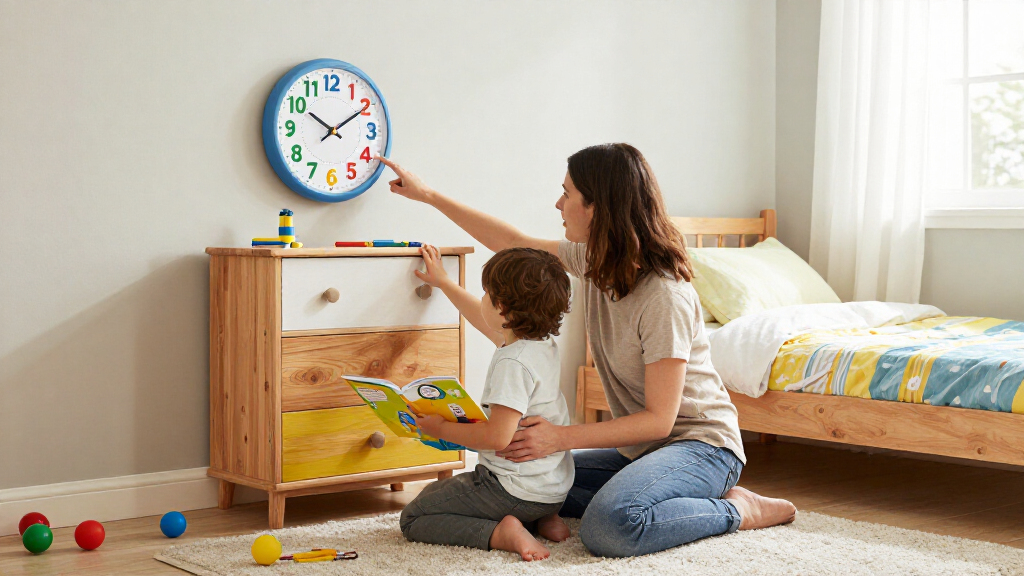
Think of the clock as a friendly prompt: a bright circle on the wall that invites a question, a guess, and a try. A few minutes at breakfast or before bedtime can help children make sense of what the hands are doing.
Choose a readable face with high-contrast numbers, distinct hands, and visible minute markings.
Teach whole hours before half-hours, quarter-hours, and minute-by-minute times; follow your child’s readiness.
Use analog clocks to show how minutes relate to hours, and digital displays to practice reading written times.
Connect the clock to familiar routines with short, encouraging questions instead of pressure.
Hang the clock where your child can see it, secure it well, and keep small batteries out of reach.
Choose a face your child can read from across the room
A child-friendly teaching clock has large, high-contrast numerals, distinct hour and minute hands, and markings that make the minutes easy to count. These details let your child focus on how the clock works instead of squinting at a decorative face. If you’re choosing between a busy cartoon design and a simple one with bold numbers, clarity is usually the better learning feature.
Check the clock from the distance where your child will actually use it. From a desk across a bedroom, tiny minute marks can disappear; a larger face with dark hands against a pale background may be much easier to follow. Some educational wall clocks use color coding or labels such as “past” and “to.” Those can help a beginner, as long as you explain the colors consistently and the extra words don’t crowd the numbers.
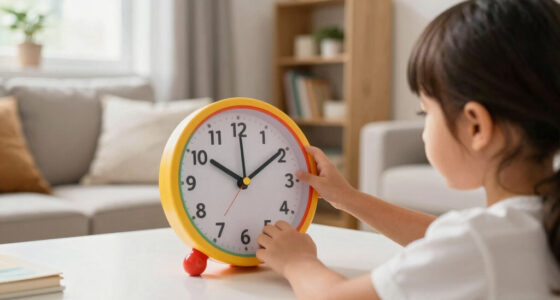
Movable hands make practice more hands-on. Your child can set the clock to 8:00 for school or turn the hands to snack time, then explain what each hand shows. For a gift, a cheerful theme can make the clock feel personal, but pause to check that the hands stand out against the artwork. A friendly fox face is lovely; a fox whose tail hides the minute marks is harder to learn from.
- Look for: clear numerals, visible minute marks, and hands that are easy to tell apart.
- Try it at a distance: imagine your child reading it from a chair, desk, or bed.
- Check hands-on use: movable hands can make short practice games easier to start.
Products Worth Considering

Greenworks 24V Cordless Brushless Leaf Blower, 515 CFM, 130 MPH, with 5.0Ah Battery and Charger

EGO Power+ 12-Inch Cordless Electric Snow Shovel with 56V 2.5Ah Battery and Charger

Worx 20V Cordless 18-Gauge Brad Nailer, WX842L
As an affiliate, we earn on qualifying purchases.
Teach the hands in small steps, from hours to minutes
Children learn to read an analog clock more easily when you introduce one kind of time at a time: whole hours first, then half-hours, quarter-hours, and finally smaller intervals. Readiness depends on skills such as recognizing numbers and counting by fives, so a product’s suggested age is only a rough guide. Let your child’s understanding set the pace.
- Start with the hour hand. Set the clock to 3:00 and point out the shorter hand. Ask your child which number it points to.
- Add the minute hand. Show that when the long hand reaches 12, you’re reading a whole hour.
- Practice half and quarter hours. Move the long hand to 6, then to 3 or 9, and connect each position to half or quarter of a turn.
- Count by fives. Each number-to-number jump represents five minutes for the long hand. Count around the face together.
- Match the hands to a routine. Set the time for lunch or leaving for school, then invite your child to make the next example.
Keep sessions short, perhaps a few minutes while you wait for toast. If your child can name 4:00 but gets tangled up with 4:30, stay with the half-hour rather than rushing ahead. Success with one small step gives the next one somewhere to land.
Knowing the clock says 3:00 is different from knowing how long it is until 3:30. Reading clock hands and understanding elapsed time are related skills, but children may need separate practice with each.
Use analog and digital clocks for different kinds of practice
An analog clock shows how minutes move around an hour, while a digital display gives the time in numerals at a glance. Children encounter both in daily life, so learning both helps them match a clock face to the times they see on phones, microwaves, or school schedules. Neither display has to do every teaching job.
| Clock style | What it makes easy to see | A useful practice moment |
|---|---|---|
| Analog | How the hands relate to hours and minutes | Trace the minute hand as it moves from 12 toward 3 |
| Digital | The written time in numerals | Match “7:30” on a display to the half-hour position on a wall clock |
| Combined | Both representations together | Compare the face and display when your child gets dressed |
For example, your child might notice 6:15 on a kitchen display. You can show where 6:15 sits on an analog clock, then point out that the minute hand has moved one quarter of the way around. Later, ask them to match a time on the wall clock to the digital display on a timer.
A combined clock can be convenient, particularly in a busy shared room, but extra lights, alarms, or sound effects don’t automatically teach time-reading. If the display distracts your child from the hands, a simpler face may serve the learning goal better. Pick the format that helps your child connect the two ways of seeing the same time.
Turn everyday routines into calm, useful clock practice
A clock becomes more meaningful when you connect it to something your child already does. Routine-based practice links a time on the wall to breakfast, putting on shoes, leaving for school, or starting a bedtime story. Familiar events give children a reason to look at the clock and a chance to use new words such as “half past.”
On Monday morning, you might point to 8:00 and say, “That’s when we put on our coats.” Later, when the minute hand is near 6, ask, “What do you notice about the time?” Your child doesn’t need to answer perfectly. The conversation itself helps connect the hands to the rhythm of the day.
Keep practice low-pressure. If the clock only appears when someone is late, it can start to feel like a warning signal. A gentler approach is to ask a quick question at a relaxed moment: “Can you set the clock for the start of your drawing time?” If your child guesses incorrectly, move the hands together and explain what changed.
- At breakfast: compare the clock with the time you plan to leave.
- Before a game: set the clock to the time the next activity begins.
- At bedtime: notice where the hands sit when the story starts.
Repeated small moments often fit family life better than a long lesson at the table. The clock can quietly support independence as your child starts to anticipate what comes next.
Make reading the shorter and longer hands feel less confusing
Children often mix up the hands because they move at different speeds, and the short hand gradually shifts between numbers as the minutes pass. The hour hand doesn’t jump from one number to the next; it creeps along while the minute hand makes a full trip around the face every 60 minutes. Showing both movements together can make this tricky idea easier to see.
Try setting the clock to 2:00 and asking your child to watch as you slowly move the minute hand toward 6. The short hand will no longer point squarely at 2; it will sit between 2 and 3. Explain that the time is half past 2, even though the hour hand has started moving toward 3. A movable teaching clock is handy here because your child can repeat the motion with their own fingers.
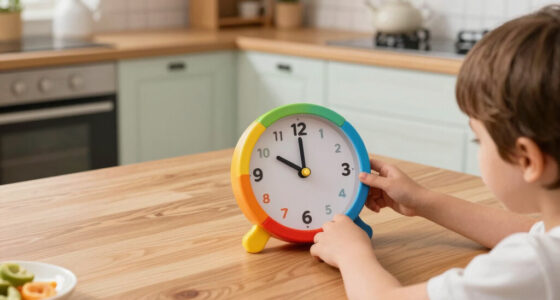
Color-coded hands may offer a helpful visual cue: for example, “the blue hand tells the minutes.” Keep the explanation steady every time you practice. If the colors change between home clocks or the labels compete with the hands, rely on length and movement instead. The aim is to help your child notice what each hand does, not memorize a color scheme.
Let mistakes show you which idea needs another example. If your child sees 2:30 and calls it 3:00, return to the shorter hand and ask whether it has reached 3 yet. A calm question gives them a way to work it out rather than turning a wrong answer into a dead end.
Hang the clock where it fits your child’s real day
The best place for a children’s wall clock is somewhere your child can see it during a routine they can practice. A spot near a desk can prompt them to notice when homework starts; a shared family area can make time part of breakfast and getting-ready conversations. Choose the viewing position first, then check that the face is readable from there.
Picture an elementary schooler sitting at a small table to draw before dinner. If the clock hangs high in a hallway, they may never glance at it. If it sits in view near the table, you can ask them to watch for the time you agreed to pack away the crayons. The clock then supports a real activity instead of becoming wall decoration.
Check practical details before mounting: select a size that suits the room, look for quiet movement if ticking might interrupt sleep or reading, and consider whether the surface is easy to clean. Mount it securely so it cannot fall if bumped. If the clock uses small batteries, keep them out of children’s reach and follow the product’s instructions for battery access.
These details matter as much as the printed learning labels. A clock that is easy to see, quiet enough for its location, and safely secured is more likely to become a useful part of the room’s rhythm.
Frequently Asked Questions
What age should a child start learning to tell time?
There’s no fixed age. Many children start exploring clocks in the early school years, when number recognition and counting by fives begin to feel familiar. If your child enjoys matching numbers or talking about daily routines, you can introduce the clock gently and follow their pace.
Is an analog clock better than a digital clock for learning?
They teach different things. Analog clocks make the relationship between hours and minutes visible, while digital displays are easy to read at a glance and common in everyday life. Practicing with both helps your child connect the face on the wall to times written in numerals.
What should I look for in a teaching clock?
Look for large, clear numerals, hands that are easy to distinguish, and minute markings your child can see from the intended viewing spot. Movable hands can make it easier to practice setting familiar times. A colorful design is fine if it doesn’t hide the clock face.
How can I make clock practice fun?
Use a quick game tied to something your child likes: set the clock to snack time, ask them to match an analog time to a digital display, or let them set the hands for the start of a board game. Keep it brief and encouraging. A few relaxed minutes can fit more naturally than a formal lesson.
Where should I hang my child’s wall clock?
Put it where your child can see it during a useful routine, such as near a desk or in a shared family space. Check that the numbers and hands are readable from their usual seat or standing spot. Mount it securely and keep small batteries out of children’s reach.
Conclusion
Choose a clock your child can read from the place they’ll use it, then build practice into a familiar moment like breakfast, homework, or bedtime. Clear hands, visible minute marks, and a few calm conversations will do more for learning than a stack of extra features.
Give your child time to watch the hands travel. One day, that bright circle on the wall may help them find their shoes before you even call out the time.