
When choosing a learning clock for a child’s room, the central question is whether the clock should teach children to read a face or make the current time easy to see. Analog learning wall clocks show moving hands around a numbered dial, giving children a way to practise hours, minutes, and the relationship between them. Digital learning clocks display numerals directly, which can be less confusing for children who are still learning number patterns or need quick reminders throughout the day.

Give the gift of listening to the book lover on your list
- Choose a 1-, 3-, 6- or 12-month membership
- They pick the audiobooks they love
- Easy to send by email

Oyster&Pop 10-Inch Silent Kids’ Analog Learning Wall Clock
- ✔ Display: Analog
- ✔ Diameter: 10 inches
- ✔ Teaching cues: Numbered minutes; labeled, color-coded hands
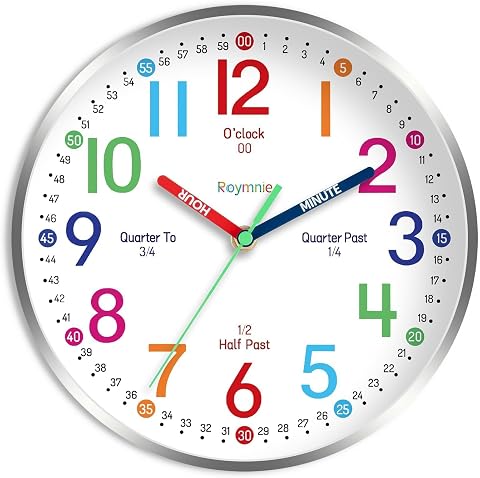
Roymnie 8-Inch Kids’ Learning Wall Clock
- ✔ Display: Analog
- ✔ Diameter: 8 inches
- ✔ Teaching cues: Color-coded hours; labeled minutes; long minute hand
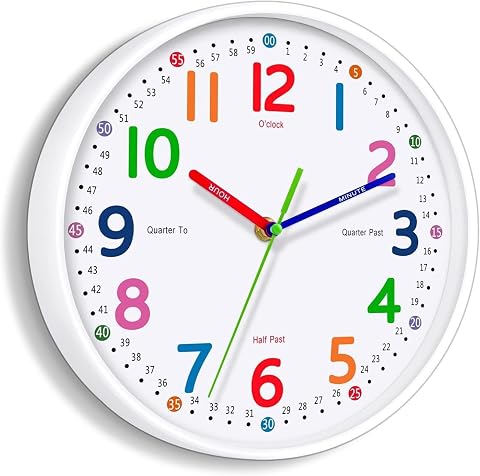
Lantoo 8-Inch Silent Kids Wall Clock
- ✔ Display: Analog
- ✔ Dimensions: 8 in W × 1.5 in H
- ✔ Teaching cues: Colorful numerals and hands
These options serve different purposes, even when both are marketed as educational. Analog is the stronger choice for building traditional clock-reading skills. Digital is easier to read, and may suit routines where recognizing the time quickly matters more than interpreting a clock face. Features and prices vary widely, so compare the display, legibility, teaching aids, durability, and sound settings before paying more. For a child learning to tell time, an analog clock is usually the better starting point; a digital clock fits children who need a simple, accessible display or already know how to read an analog face.
At a Glance
| Criteria | Analog learning wall clocks | Digital learning wall clocks | Winner |
|---|---|---|---|
| Time-reading practice | Builds practice reading hands, hours, and minutes together | Shows time in numerals; limited practice reading clock faces | A |
| At-a-glance readability | Requires interpreting hand positions before reading the time | Direct display is quick to scan | B |
| Support for early learners | Numbered dials and clear labels can guide practice | Familiar number format may help children who find clock hands difficult | Depends |
| Routine and alarm features | Often offers a basic clock display; features vary by model | Some models include alarms, timers, or night displays | B |
| Room placement and visibility | Large face can be easy to read from across a room | Bright or small digits may be hard to see at a distance | Depends |
| Value | Often a straightforward purchase focused on learning clock faces | Added features can be useful, but may raise the cost | Depends |
Oyster&Pop 10-Inch Silent Kids’ Analog Learning Wall Clock
The Oyster&Pop gives a beginning learner the most explicit help in this lineup. Its face has numbered minutes and labeled, color-coded hands, so children can connect each hand with its role instead of relying only on color or guesswork. Compared with the Roymnie and Lantoo, its 10-inch dial is also larger, which can make the markings easier to spot from a bed or classroom table. A printable teaching activity e-book extends the clock’s use beyond simply hanging it on the wall.That added teaching detail makes this our best overall choice, but the larger size may be less convenient on a crowded wall than either 8-inch alternative. Its wood-effect frame gives it a different look from the plastic Roymnie and white ABS Lantoo, though the listed face material is acrylic, not glass or wood. The movement is silent and sweeping, a useful shared benefit across all three picks. Families should also account for the required AA battery, which is not stated as included, and keep this indoor-only clock away from outdoor spaces.
Pros:
- Numbered minutes and labeled, color-coded hands provide clear teaching cues.
- The 10-inch face is larger than the two 8-inch alternatives.
- Silent sweeping movement avoids ticking in quiet rooms.
- Includes a printable teaching activity e-book and a one-year warranty.
Cons:
- Requires one AA battery, and inclusion is not specified.
- Indoor use only; its larger face may take more wall space than compact picks.
Best for: Families or teachers helping a beginner learn both hour and minute reading, especially where a larger, clearly marked dial is useful.
Not ideal for: Buyers who need the smallest clock for a tight wall, want an outdoor-rated model, or prefer not to source a separate AA battery.
Bottom line: For the clearest all-around teaching setup in this group, we would choose the Oyster&Pop, provided its larger footprint suits the room.
“For the clearest all-around teaching setup in this group, we would choose the Oyster&Pop, provided its larger footprint suits the room.”
Roymnie 8-Inch Kids’ Learning Wall Clock
For a smaller wall, the Roymnie preserves several useful learning cues in an 8-inch format. Its hours are color-coded and its minutes are labeled; the description also notes a long minute hand that points toward the minute markings. Those details make it more instructive than a clock with color alone, while the smaller face gives it an advantage over the Oyster&Pop when space is limited. Its silent continuous-sweep movement suits bedrooms and classrooms just as well as the other two options.The compact size involves a visibility tradeoff: families choosing between this and the larger Oyster&Pop should consider how far away the child will read the dial. The Roymnie’s plastic construction is also more utilitarian than the Oyster&Pop’s wood-effect styling, and its listed details do not include a warranty. Compared with the Lantoo, its labeled minutes and long minute hand make the teaching approach more explicit, while both clocks remain compact, indoor, battery-powered options. One AA battery is required but not included.
Pros:
- Color-coded hours and labeled minutes support reading practice.
- Long minute hand points toward the minute markings.
- Compact 8-inch size can fit smaller walls.
- Silent continuous-sweep movement is suited to bedrooms and classrooms.
Cons:
- Plastic construction offers a simpler finish than the Oyster&Pop’s wood-effect frame.
- One AA battery is not included.
- No warranty is listed in the supplied specifications.
Best for: Families looking for an 8-inch clock that labels minutes and distinguishes hours by color for a child learning the basics.
Not ideal for: Buyers who need a larger face for viewing across a room, want a non-plastic frame, or prioritize a stated warranty.
Bottom line: We recommend the Roymnie when compact size and labeled minute cues matter more than a larger face or a stated warranty.
“We recommend the Roymnie when compact size and labeled minute cues matter more than a larger face or a stated warranty.”
Lantoo 8-Inch Silent Kids Wall Clock
The Lantoo is the straightforward compact option: colorful numerals and hands give children visual prompts, and its 8-inch face fits the same smaller-wall niche as the Roymnie. It also has silent sweeping quartz movement and a white ABS frame, keeping its listed design simple for bedrooms or classrooms. A one-year warranty is specified, which gives buyers a concrete coverage detail that is not listed for the Roymnie.Its learning guidance is less explicit in the supplied description than the other two clocks. The Oyster&Pop labels color-coded hands and numbers the minutes, and the Roymnie specifies labeled minutes and a long minute hand; the Lantoo lists colorful numerals and hands without those additional cues. That makes it better suited to reinforcing basic number and hand recognition than to a learner who needs the dial to explain minute reading. It has no alarm, and while that keeps the feature set simple, families looking for an alarm function should choose another product. As with the other picks, it requires a separate AA battery and is intended for indoor use.
Pros:
- Colorful numerals and hands offer visual cues for early learning.
- Silent sweeping movement suits quiet indoor spaces.
- Compact 8-inch size works for bedrooms and classrooms.
- A one-year warranty is listed.
Cons:
- The supplied description does not specify labeled minute markings.
- No alarm function.
- Requires one AA battery, not included.
Best for: Buyers who want a compact, colorful learning clock with silent movement and a stated one-year warranty.
Not ideal for: Children who need labeled minute markings or especially explicit hand-to-time guidance, or families who want an alarm.
Bottom line: The Lantoo makes sense for a simple, colorful compact clock when a stated warranty matters more than detailed minute-reading cues.
“The Lantoo makes sense for a simple, colorful compact clock when a stated warranty matters more than detailed minute-reading cues.”
As an Amazon Associate we earn from qualifying purchases.
Key Differences
The biggest difference is what the child must do to get the time. With an analog clock, the child reads the hands and connects their positions to the hour and minute numbers. That effort is the teaching value: repeated everyday glances can reinforce a skill that a digital display does not practise. A digital clock removes that interpretation step, which makes it better for quick checks and can help a child follow schedules without first mastering the clock face.
That ease comes with a tradeoff. A digital display can tell a child that it is 7:30, but it does not show why the minute hand points where it does or how the hands move through an hour. Conversely, an analog clock can frustrate a beginner if its face is crowded, its hands are hard to distinguish, or the child is not yet ready to read the dial. A clearly labeled teaching face makes analog practice more approachable; a plain face may suit a child who already understands the basics.
Neither type is automatically better value. For a clock whose main job is teaching time, a legible analog model is usually enough. Paying extra for a digital model makes sense when features such as an alarm or timer will support a real household routine, or when a direct numeric display is the child’s priority. Check visibility, controls, and sound settings as well as the feature list: a clock that is difficult to read or operate will see less use.
Detailed Comparison
Time-reading practice (Analog learning wall clocks wins — major)
Analog clocks win by a major margin when the goal is learning to read a traditional clock face. Children practise interpreting the hour hand and minute hand each time they check the display. A digital clock gives the answer in numerals, so it can help with time awareness but offers little direct practice with hand positions. Choose analog when clock-reading is the lesson; choose digital when access to the current time is the priority.
At-a-glance readability (Digital learning wall clocks wins — moderate)
Digital clocks have a moderate advantage for quick checks because the time appears as familiar numerals. Children do not have to work out which marks a hand points toward. Analog can still be easy to scan once the child knows the dial, especially with large numbers and clear hands. For an early learner who cannot yet read the face, digital is the more immediately legible option.
Support for early learners (moderate difference)
This depends on the child and the clock design. An analog teaching face with clear hour numbers, minute markers, and distinct hands can break a new skill into visible parts. A digital display may feel simpler for children who recognize numerals but are not ready to interpret a dial. The gap is moderate because age, number confidence, and the clarity of the design all affect how approachable each clock feels.
Routine and alarm features (Digital learning wall clocks wins — minor)
Digital clocks often have an advantage when a child needs an alarm, timer, or night display, although the available functions vary by model. Those tools can support waking up or following a bedtime routine. A basic analog clock may be simpler, but it may not offer the same prompts. The gap is minor if the clock is mainly for learning; it matters more when the family will use extra features every day.
Room placement and visibility (minor difference)
Neither format wins in every room. A large analog face with bold numbers may be readable from across the room without a bright display. Digital clocks can be compact and easy to place on a shelf, but small digits or a dim display may be difficult to see from the bed. Compare the display size and viewing distance for the intended spot; the design matters more than the format alone.
Value (moderate difference)
Value depends on the job the clock must do. A basic analog clock can offer strong value when the aim is practising time-reading, since extra functions are not required for that lesson. Paying more for digital features is worthwhile if alarms, timers, or a numeric display will be used regularly. If those extras will go unused, a simpler clock is the better buy. Prices and features differ by model, so compare like for like.
Analog learning wall clocks: Pros and Cons
Pros:
- Practises reading hours and minutes from a clock face
- A clear teaching dial can make hand positions easier to understand
- Can be read without a glowing digital display
Cons:
- Beginners must interpret the hands before knowing the time
- Crowded dials or similar-looking hands can be confusing
- May lack alarms or other routine features
Digital learning wall clocks: Pros and Cons
Pros:
- Numerals make the time quick to recognize
- May include alarms, timers, or night displays
- Can suit children who find clock faces difficult
Cons:
- Does not teach children to read the hands on a traditional clock
- Small or dim numerals may be hard to see
- Extra functions can add cost without adding value if unused
Who Should Choose What
Choose Analog learning wall clocks if:
- Your main goal is teaching a child to read an analog clock face.
- The child can practise with a clearly marked dial and distinct hands.
- You want a straightforward learning display without needing alarms or timers.
Choose Digital learning wall clocks if:
- Your child needs to check the time quickly during a routine.
- A digital display feels more accessible than a clock face for your child.
- You will use an alarm, timer, or other feature included with the model.
Skip both if: Skip both formats if the clock’s display is too small or confusing for your child, or if you need a feature the models you are considering do not offer. Look for a simpler, more legible clock that fits the intended room and routine.
Value for Money
For teaching traditional time-reading, a well-designed analog clock is usually the better value: it gives the child practice with the skill itself, and a basic face may be all that is needed. Pay more for an analog model only if clearer markings, larger numbers, or sturdier construction solve a specific need. A digital clock can justify its higher cost when the child needs a direct readout or will use an alarm, timer, or night display regularly. If the added functions will sit unused, the extra spend is hard to justify.
Compare the actual display and controls before comparing feature counts. A bright, small digital display may be less useful in a child’s room than a larger, clearer face, while an analog clock with crowded markings may not teach well. Value comes from choosing a clock the child can see and use consistently.
Final Verdict
Choose an analog learning wall clock for a child whose main goal is learning to read the hands and understand hours and minutes. It is the better teaching tool for that specific skill, provided the face is clear and suited to the child’s level. Choose digital if quick recognition, accessibility, or daily alarm and timer features matter more than practising an analog dial. The deciding factor is whether the clock’s primary job is to teach clock-face reading or to make the current time immediately clear. For most families buying specifically to teach time, start with a legible analog model and pay more for digital only when its display or routine features will see regular use.
Frequently Asked Questions
Which type of learning clock is better for teaching a child to tell time?
An analog clock is better for practising traditional time-reading because the child has to interpret the hour and minute hands. Choose one with a clear face, distinct hands, and markings that match the child’s learning level.
Is a digital clock easier for a young child to read?
Often, yes. A digital clock displays the time as numerals, which can make quick checks easier for a child who recognizes numbers but has not learned to read a clock face.
Should I buy both an analog and a digital clock?
Buy both if the child will use each for a different purpose: analog for clock-face practice and digital for quick checks or alarms. If you want just one clock, choose based on which of those jobs matters more.
Are extra features worth paying more for?
Pay more for alarms, timers, or a night display when those features support a routine the child will actually use. For learning to read an analog face, clear markings matter more than a long list of extras.