
TL;DR

Get decor and gifts delivered free with Prime
- Fast, free delivery on millions of items
- Prime Video, Amazon Music and more included
- Member-only deals all year
A Livingetc report explains kogei as a Japanese tradition of everyday objects shaped by local materials, inherited knowledge and human judgment—not simply by hand production or individual artisans. It also highlights the decline in workers in Japan’s traditional craft industries and the regional networks needed to sustain them.
Livingetc has published an explainer on kogei, describing it as a Japanese tradition of useful objects rooted in local materials, accumulated knowledge and makers’ judgment. The report says the approach is broader than handmade production or the work of a single celebrated artisan, and points to a steep decline in employment across Japan’s traditional craft industries.
Tasuku Ogino, executive vice president of Nakagawa, defines kogei as everyday tools shaped by practical knowledge passed down through generations, regional ways of life and the skills of their makers. Nakagawa, founded in Nara in 1716, says it now works with more than 800 workshops across Japan. The company’s account is presented in the Livingetc report.
The report distinguishes kogei from objects made primarily to be admired and from industrial production focused on uniformity and efficiency. An object need not be rare, expensive or signed to fit the idea. Its usefulness, connection to a place and continuity of knowledge matter more than its status as a collectible or the method used to manufacture it.
One example is Nakagawa’s Hana Fukin kitchen cloth, made from kaya fabric, a breathable mosquito-net material associated with Nara. The cloth is woven on machines, but operators adjust production for humidity and the habits of individual looms. The report presents those decisions as evidence that human judgment can remain central even when machinery is involved.
Why Regional Craft Networks Matter
The report’s account shifts attention from the appearance of an individual object to the people, materials and skills that make its continued production possible. That matters to readers interested in interiors because kogei frames everyday items—a cloth, bowl or kettle—as part of a place-based tradition, rather than as decoration alone. It offers a way to notice design through use, construction and local history.
There is also an economic and cultural concern. The report says Japan’s traditional craft industries employed 288,000 people in 1979, compared with 48,334 in 2022. Those figures indicate a substantial decline in the workforce, although the source does not provide a breakdown by trade, region or cause. As Ogino describes it, sustaining kogei means supporting the regional production networks, not only preserving a particular product or technique.
As an affiliate, we earn on qualifying purchases.
Kogei Beyond Handmade Objects
Kogei is written 工芸 in Japanese. The Livingetc report says Japanese distinguishes among art, craft and everyday craft, placing kogei in the latter category. Its central test is not whether an object was made entirely by hand, but whether it is connected to a region and its accumulated knowledge, and whether human decision-making remains part of production.
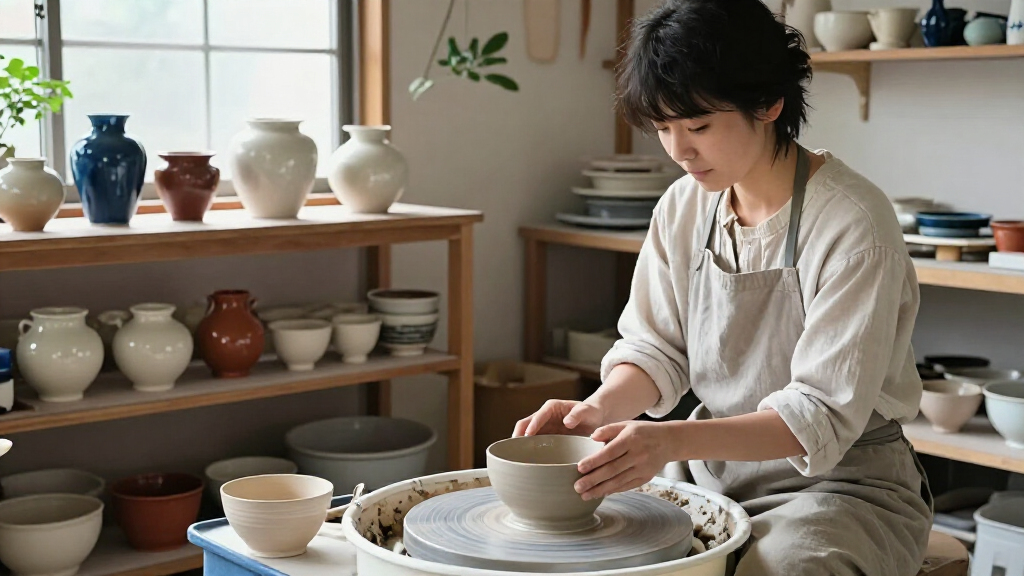
Production may involve several specialists. A ceramic piece, for example, can pass through people responsible for clay, glaze, molds and firing. The report describes this division of labor as characteristic of traditional production in some regions, where each specialist depends on the others. Japan also has an official register of Living National Treasures, but the report stresses that everyday craft is often collective rather than the work of one recognized master.
The report says Japan’s government list of traditional crafts contains 244 crafts, with at least one represented in each of the country’s 47 prefectures. It states that the criteria begin with everyday use. The figures and definitions are reported by Livingetc; the article does not give further detail on the list’s individual eligibility rules.
As an affiliate, we earn on qualifying purchases.
What the Workforce Figures Leave Open
The workforce comparison is a broad national count, not a measure of how many people work in each craft or how the decline has varied across regions. Livingetc does not identify the source methodology, explain what factors drove the change, or provide figures after 2022. The data therefore show a decline between the cited years, but do not establish its causes or the present size of the workforce.
The report also does not quantify how many of the 244 listed crafts face an immediate risk of disappearing, or how many workshops are currently able to train new workers. Nakagawa’s description of its network and aims is the company’s account; it is not an independent assessment of the condition of every regional craft industry.
As an affiliate, we earn on qualifying purchases.
Keeping Workshops and Skills Active
The report identifies continued use and support for regional production networks as the issue ahead, but it does not announce a new government program, funding package or preservation target. Nakagawa says it hopes to pass on the ecosystems that enable kogei, while its work with workshops offers one example of a company’s role in that effort.
Readers seeking to apply the idea at home can look beyond labels such as “handmade” and ask where an object’s materials come from, which skills shaped it and how it is intended to be used. That is an interpretation of the report’s account, not a formal test or certification. The broader outlook for Japan’s craft workforce remains uncertain without newer employment data and details of support for individual trades.
As an affiliate, we earn on qualifying purchases.
Key Questions
What does kogei mean?
Kogei refers to everyday objects shaped by regional materials, inherited knowledge and makers’ skills. In the Livingetc report, the emphasis is on practical use and a connection to place.
Does an object have to be handmade to count as kogei?
No. The report says the use of a machine does not rule out kogei. What matters is whether local knowledge and materials inform the object and whether human judgment remains part of production.
Does kogei usually involve one master artisan?
Not necessarily. The report describes many everyday crafts as collective work involving specialists in different stages, such as clay, glaze and firing. It distinguishes that shared production from the separate tradition of celebrated master artisans.
How has employment in Japan’s traditional craft industries changed?
Figures cited by Livingetc put employment at 288,000 in 1979 and 48,334 in 2022. The report does not provide later figures or explain the causes of the decline.
Source: rss
Halloween Picks
halloween
As an affiliate, we earn on qualifying purchases.