
TL;DR

Get decor and gifts delivered free with Prime
- Fast, free delivery on millions of items
- Prime Video, Amazon Music and more included
- Member-only deals all year
An art historian and an interior designer interviewed by Veranda describe how artwork’s colors, forms and personal associations may affect feelings at home. They stress that responses vary between people, so art is not a reliable way to produce a specific emotional effect for everyone.
A Veranda report on the emotional effects of art at home brings together comments from art historian Susie Hodge and interior decorator Cameron Jones, who say color, shape and personal associations can influence how people respond to a room. How to choose art that feels right can also depend on these personal responses. Their central qualification is that no artwork produces the same reaction in everyone: a piece one person finds calming may make another uneasy.
Hodge, author of How Art Can Change Your Life, says viewing art a person finds pleasing can produce a dopamine response. For advice on starting an art collection, gallery owners also emphasize choosing pieces you love. She compares a strong positive reaction to the euphoric feelings associated with being in love. The report presents this as Hodge’s explanation; it does not supply research methods or clinical evidence to establish how often that response occurs.
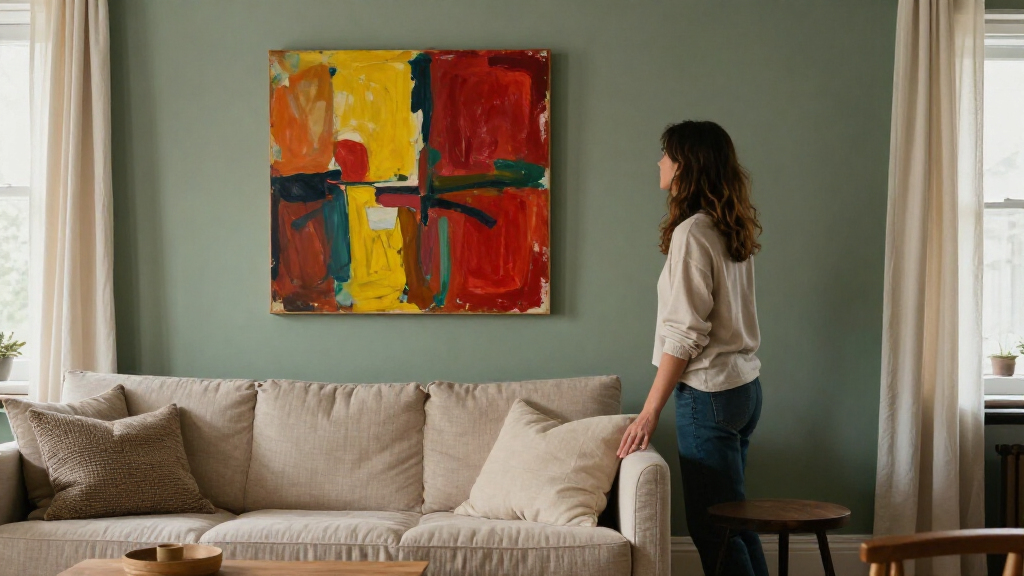
Jones says she asks clients how they want to feel in a particular room before helping them choose its design. In her examples, greens, blues and muted neutrals may suit a bedroom intended to feel calm, while a sunny yellow may bring energy to a breakfast room. Art can add a measured amount of color where homeowners do not want to use it across walls or furnishings.
The experts also discuss visual form. Jones says some clients feel calmer around abstract art with rounded shapes and softer lines. Hodge describes smooth lines, circles, soft colors and horizontal compositions as qualities that can feel peaceful, while sharp angles, jagged lines and forceful colors may feel energizing or unsettling. These are observations, not universal rules: viewers’ memories and preferences can alter the effect.
Choosing Art for the Mood at Home
The report’s practical message is that artwork can be part of how people shape the feeling of a room, without requiring a full redesign. A colorful painting may supply an accent in a neutral space, while softer forms may suit someone seeking a quieter atmosphere. This gives homeowners another way to think about art beyond matching it to furniture or treating it only as decoration.
But the advice is best understood as a starting point, not a prescription. Hodge and Jones both stress the subjective nature of art. A painting associated with a difficult memory may provoke discomfort, even if its palette or style is often described as soothing. The report does not show that selecting art by color or shape will reliably change someone’s mental health or emotional state.
Products Worth Considering

Bosch GTS15-10 10-Inch Portable Jobsite Table Saw with Gravity-Rise Wheeled Stand

EGO Power+ 3-Gallon Compact Cordless Wet/Dry Vacuum, 85 CFM (WDV0300)

DEWALT DCN680D1 20V MAX Cordless 18-Gauge Brad Nailer Kit
As an affiliate, we earn on qualifying purchases.
Experts Link Color, Form and Memory
The report draws on examples from artists whose work foregrounds color. Hodge says Agnes Martin sought to replace stressful feelings with calm, positive thoughts, and points to Martin’s blue painting Night Sea, held by the San Francisco Museum of Modern Art, as an example of that aim. She also cites Henri Matisse’s belief that colors could affect viewers, including his remark that a certain blue could enter the soul and a red affect blood pressure.
Hodge describes Mark Rothko as an artist interested in expressing basic human emotions and says some viewers cried in front of his paintings. She also uses Andy Warhol’s Campbell’s soup imagery to make a point about inspiration: everyday objects can become artistic subjects. These examples reflect artists’ intentions and expert interpretation; they do not establish that every viewer experiences the works in the same way.
“When we see art that we find pleasing, it gives us a dopamine rush.”
— Susie Hodge, art historian and author
How Individual Reactions Differ
The report does not establish a scientific measure for how particular colors or forms affect mood, nor does it quantify how long any response might last. Hodge’s dopamine description and the designers’ observations are attributed perspectives; the supplied material does not include studies, sample sizes or clinical findings to assess them.
It is also unclear how much a person’s response comes from the artwork itself, its setting, or memories attached to it. Both experts emphasize that personal experience matters. The report therefore supports a discussion of possible reactions, not a guarantee that a certain painting will create calm, joy or energy.
How Homeowners Can Apply the Advice
The report offers no announced follow-up study or policy change. For homeowners, the next step suggested by the experts is to notice their own reactions: consider what feeling they want in a room, then look at whether a work’s palette, shapes or associations fit that preference. Trying a piece in the intended space can help reveal whether it feels comfortable there.
Any choice remains personal. A homeowner may prefer vivid color in a bedroom or find a muted abstract work unsettling. The experts’ comments offer ways to think about those choices, while the report leaves open how consistently art can affect mood across different people and circumstances.
Key Questions
Can art at home affect how people feel?
Hodge and Jones say artwork may influence feelings through color, shape and personal associations. The report also stresses that responses vary and are not guaranteed.
What kinds of art may feel calming?
Jones says some clients feel calmer around abstract works with rounded shapes and soft lines. Hodge also identifies gentle colors, smooth lines, circles and horizontal compositions as potentially peaceful qualities.
Does a particular color create the same mood for everyone?
No. The experts say people’s memories, preferences and experiences affect how they interpret art, so the same color or painting can prompt different reactions.
Does the report prove that art can improve mental health?
No. It reports expert perspectives and examples, but the supplied material does not include clinical evidence showing that choosing particular artwork treats or improves a mental-health condition.
Source: veranda.com