TL;DR
Listen free for 30 days with Audible
Thousands of audiobooks and originals — cancel anytime.
Start your free trialAs an affiliate, we earn on qualifying purchases.
Atomic (radio-controlled) clocks automatically sync with signals from atomic time standards, ensuring they stay incredibly accurate. They’re reliable, low-maintenance, and used worldwide for precise timekeeping.
Imagine a clock so precise that it keeps perfect time without you ever needing to set it. That’s the magic behind atomic (radio-controlled) clocks. They automatically synchronize with signals broadcast by atomic standards, ensuring your time is always exact, down to the second.
Whether hanging on your wall, ticking on your desk, or embedded in your smartphone, these clocks combine cutting-edge science with everyday convenience. Understanding how they work can help you appreciate the quiet power behind your most reliable timepieces.
Atomic clocks are the most precise timekeeping devices, defining the second globally.
Radio-controlled clocks automatically sync with signals from atomic standards, requiring no manual adjustment.
Signal reception can be blocked, so in remote areas, clocks might need manual resets or alternative methods.
Recent tech combines radio signals with internet and GPS for higher reliability and more features.
Understanding signal sources helps you choose the right clock and troubleshoot reception issues.
How Do Atomic (Radio-Controlled) Clocks Keep So Precise?
Atomic (radio-controlled) clocks are driven by the vibrations of atoms—most often cesium or rubidium—that oscillate with astonishing regularity. These vibrations form the basis of the world’s most accurate clocks, measuring time with incredible consistency.
For everyday use, these clocks receive signals from dedicated radio stations linked directly to atomic clocks. Once the signal is received, the clock adjusts itself automatically, aligning perfectly with the standard time.
Think of it like a ship’s autopilot, constantly fine-tuning its course based on a global navigation system, ensuring it stays on track without manual input.

La Crosse Technology WT-3129B 12 Inch Atomic Analog Wall Clock, Pack of 1, Black
- Automatic Time Sync: Syncs with WWVB radio for accuracy
- Elegant Classic Design: Black matte frame with silver bezel
- Long Battery Life: Operates up to 5 years on 3 AA batteries
As an affiliate, we earn on qualifying purchases.
As an affiliate, we earn on qualifying purchases.
What Makes Radio-Controlled Clocks So Reliable?
The secret sauce is in the regular signals broadcast from stations like WWVB (USA), DCF77 (Germany), MSF (UK), and JJY (Japan). These signals carry the exact time, based on a network of atomic clocks worldwide, maintained by national and international agencies.
Once your clock’s radio receiver picks up this signal—often once a day—it adjusts itself to match the precise atomic time. The result? A clock that stays accurate for years, with minimal intervention.
Imagine setting a traditional clock, then never adjusting it again. That’s the power of radio-controlled technology.
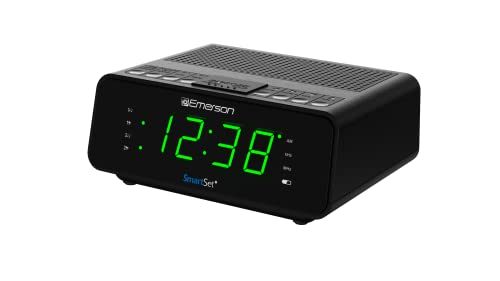
Emerson CKS1900 SmartSet Dual Alarm Clock Radio with AM/FM Digital Tuning, Auto Time Setting, 20 Presets, Jade Green LED Display, Snooze, Sleep Timer & Battery Backup
- Auto Time and Date Setting: SmartSet technology automatically sets time and date
- Battery Backup: Maintains time and alarm during power outages
- Jade Green LED Display: Large, clear display with adjustable brightness
As an affiliate, we earn on qualifying purchases.
As an affiliate, we earn on qualifying purchases.
The Different Types of Radio-Controlled Clocks
Radio-controlled clocks aren’t just wall clocks. They come in various forms—wristwatches, alarm clocks, desk clocks, and even some smart devices. Each type connects to the atomic time signals to keep you punctual.
For example, a popular wall clock might synchronize every night, adjusting for daylight saving time automatically. Meanwhile, a wristwatch might sync every morning during your routine, ensuring you’re always on time.
This variety means you can find a radio-controlled clock for nearly any space or style, all with the same core accuracy.

Hearkent Atomic Talking Watch for Elderly,Blind,Loud Clear English Voice
- Multiple Strap Options: Elastic band and leather strap choices
- Radio-Controlled Time: Automatically updates at 3 a.m.
- Adjustable Time Zones: Set for four U.S. time zones
As an affiliate, we earn on qualifying purchases.
As an affiliate, we earn on qualifying purchases.
Pros and Cons: Should You Rely on Radio-Controlled Clocks?
Pros include exceptional accuracy—often within a second over millions of years—and automatic adjustments for daylight saving time. They require no manual setting, saving you time and frustration.
However, they depend on radio signals. In areas with tall buildings, mountains, or underground spaces, signals may be blocked, causing temporary inaccuracies or needing manual resets.
Think of it like a smartphone’s GPS: reliable most of the time, but sometimes hindered by obstacles. This reliance on signals means that in certain environments, the clock’s accuracy can be compromised, which might be problematic for critical timing needs.
Understanding these tradeoffs helps you decide when a radio-controlled clock is best suited for your needs and when alternative options might be necessary.
Emerson CKS1900 SmartSet Dual Alarm Clock Radio with AM/FM Digital Tuning, Auto Time Setting, 20 Presets, Jade Green LED Display, Snooze, Sleep Timer & Battery Backup
- Auto Time and Date Setting: SmartSet technology automatically sets time and date
- Battery Backup: Maintains time and alarm during power outages
- Jade Green LED Display: Large, clear display with adjustable brightness
As an affiliate, we earn on qualifying purchases.
As an affiliate, we earn on qualifying purchases.
Latest Tech Trends Making Atomic Clocks Smarter
Recent innovations blend radio control with digital connectivity. Many clocks now sync via the internet or GPS signals, providing even greater accuracy and redundancy. This hybrid approach reduces the risk of losing time due to signal issues.
For instance, some smart clocks combine radio signals with Wi-Fi, automatically updating time and weather data. Imagine a clock that’s not only precise but also a mini weather station and smart home hub.
These trends show a future where your clock is constantly learning and adjusting, staying perfectly in sync no matter what.
Where Do These Signals Come From — And Why Are They So Accurate?
Signals like WWVB (USA), DCF77 (Germany), and MSF (UK) originate from highly precise atomic clocks maintained by national agencies. These stations broadcast time signals that are synchronized with international atomic time, which is based on a global network of atomic clocks.
These signals are so accurate because they are derived from the most stable and fundamental atomic vibrations, which serve as a universal standard. The implications are significant: relying on these signals means your clocks are synchronized to a universal time standard that is continuously refined and monitored for consistency. This level of precision ensures global synchronization for scientific, navigation, and communication systems, making it the backbone of modern timekeeping infrastructure.
According to an anonymous researcher, the accuracy of these signals is so high that they serve as the standard for defining a second—currently 9 billion vibrations of cesium atoms.
So, when your clock’s receiver catches the signal, it’s syncing with one of the most reliable time sources on Earth.
Can You Use an Atomic Clock Anywhere? What Are the Limits?
Atomic clocks are designed to work within the broadcast range of their signals. In the US, for example, WWVB’s signal reaches most of North America, but in remote rural areas or underground basements, reception can falter.
If you live in a mountain cabin or a deep subway, your clock might need manual help or alternative syncing methods like internet time.
Think of it as trying to catch a radio station—if your antenna is blocked or weak, you might miss the broadcast temporarily. This limitation underscores the importance of understanding your environment when choosing a timekeeping device—especially if precise timing is critical for your work or activities. It also highlights the value of having backup synchronization methods, such as internet-based or GPS time sources, which can operate independently of radio signals.
Frequently Asked Questions
How accurate are atomic (radio-controlled) clocks?
They are incredibly precise—often within a second over millions of years—thanks to their synchronization with atomic time standards maintained worldwide.
Do radio-controlled clocks work everywhere?
They work best within the broadcast range of their signals. In remote or obstructed areas, signals can be weak or blocked, leading to temporary inaccuracies.
Are atomic clocks the same as atomic watches?
Atomic clocks are the ultra-precise devices used as standards, while atomic watches are consumer gadgets that sync with these standards via radio signals.
Can I manually set or override a radio-controlled clock?
Yes, but manual adjustments often interfere with automatic synchronization. It’s usually best to let the clock do its thing.
Are there alternatives to radio-controlled clocks for precise timekeeping?
Yes, internet time synchronization and GPS-based clocks provide high accuracy, especially where radio signals are weak or unavailable.
Conclusion
Atomic (radio-controlled) clocks are a quiet marvel, blending atomic physics with everyday life. They give you peace of mind, knowing your time is always accurate—no fuss, no manual resets.
Next time you glance at a perfectly synchronized clock, remember it’s powered by some of the most precise measurements in science, silently working behind the scenes.
Grilling season Picks
grills
As an affiliate, we earn on qualifying purchases.