
TL;DR

Get decor and gifts delivered free with Prime
- Fast, free delivery on millions of items
- Prime Video, Amazon Music and more included
- Member-only deals all year
Mechanical clocks rely on a power source, gear train, escapement, and oscillator to keep time. Recent innovations improve accuracy and preserve tradition, making these timepieces both functional and beautiful.
Mechanical clocks have fascinated humanity for centuries, combining intricate engineering with precise timekeeping. Despite the advent of digital technology, they remain marvels of craftsmanship and engineering. Understanding their core components—gears, escapements, and springs—reveals how they keep accurate time through mechanical means.
The escapement is the vital component that converts continuous energy into controlled, periodic impulses, making the clock tick reliably.
Gear ratios carefully divide the movement into seconds, minutes, and hours, translating mechanical motion into readable time.
Modern advances in materials and design have improved accuracy and longevity without sacrificing traditional craftsmanship.
The oscillator—pendulum or balance wheel—sets the clock’s rhythm, maintaining consistent timing over centuries.
Understanding these parts reveals the delicate harmony behind every classic clock, blending physics and artistry.
What Powers a Mechanical Clock? The Spring or Weight
The main power source in a mechanical clock is either a tightly wound mainspring or descending weights. The mainspring stores energy when wound and unwinds slowly, releasing power to drive the gear train. In weight-driven clocks, gravity pulls the weights down, providing a steady force. Imagine winding a pocket watch—you’re tightening that tiny spring, ready to keep time for hours.
As an affiliate, we earn on qualifying purchases.
How Gears Turn Power Into Time: The Gear Train
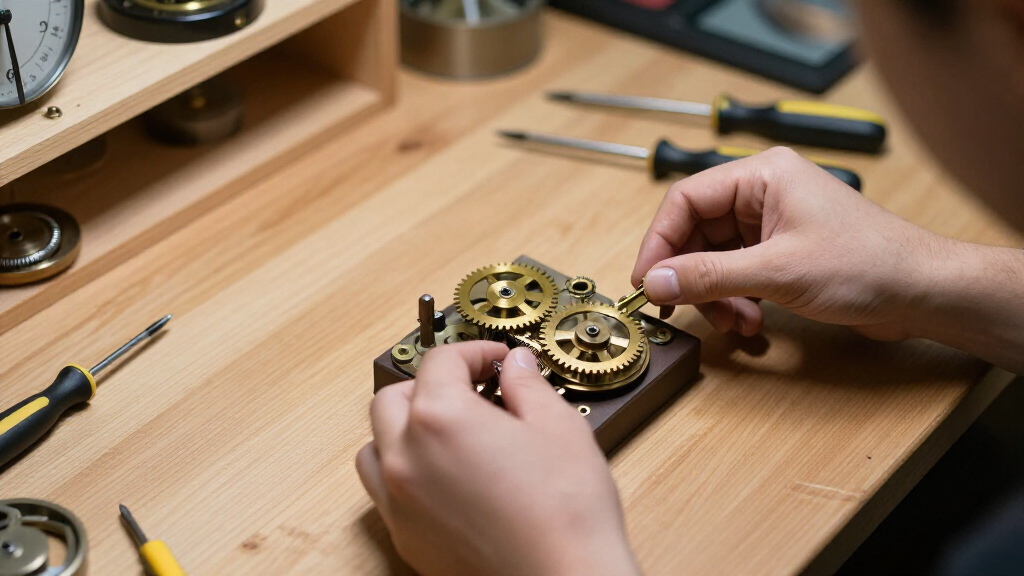
The gear train acts like the clock’s nervous system. It transmits the energy from the spring or weights to the escapement, dividing it into precise intervals. Think of a row of interconnected cogs—each gear ratio carefully calibrated. For example, one full rotation of the second gear moves the minute hand slightly, translating mechanical motion into readable time. The design of this gear train is crucial because it determines the accuracy and reliability of the clock. A poorly calibrated gear ratio can lead to time drifts, which is why master clockmakers spend hours fine-tuning these ratios. The complexity of the gear train also reflects a tradeoff: more gears can improve precision but increase mechanical complexity and potential points of failure. Thus, the gear train embodies a balance between precision, durability, and craftsmanship.
As an affiliate, we earn on qualifying purchases.
What Is an Escapement—and Why Is It the Heart of the Clock?
The escapement is the device that controls the release of energy, creating the clock’s characteristic ticking sound. It works like a gatekeeper, allowing the gear train to move forward in tiny, regular steps. This regulation is vital because it ensures the clock’s hands move at a consistent rate, despite variations in energy release from the mainspring or weights. The escapement’s design determines the clock’s accuracy and stability; for example, a well-made escapement minimizes energy loss and maintains a steady tick, which directly affects timekeeping precision. The interaction between the escapement and the oscillator (pendulum or balance wheel) is a delicate dance—if the escapement releases energy unevenly, the clock’s accuracy suffers. Therefore, the escapement is not just a component but the heartbeat of the mechanical clock, dictating its reliability and performance over time. Its development over centuries reflects a continuous effort to improve precision while managing the tradeoffs between complexity, energy efficiency, and durability.
mechanical clock escapement mechanism
As an affiliate, we earn on qualifying purchases.
As an affiliate, we earn on qualifying purchases.
Oscillators: The Clock’s Metronome
The oscillator sets the clock’s pace. Most mechanical clocks use a pendulum or a balance wheel that swings or rotates at a consistent frequency—like a metronome. For example, a pendulum swinging back and forth every second keeps the clock ticking reliably. The oscillator’s stability is critical; even tiny variations in length or mass can cause time errors. This is why clockmakers meticulously craft and adjust these components—ensuring the pendulum is perfectly calibrated and that external factors like temperature or air resistance are minimized. The oscillator’s ability to maintain a steady rhythm over long periods is what allows mechanical clocks to keep accurate time, sometimes for days or even weeks before needing adjustment. Its importance lies in its role as the clock’s heartbeat, translating the physical motion into a reliable measure of time that underpins the entire mechanism’s precision and reliability.
As an affiliate, we earn on qualifying purchases.
Bringing It All Together: How Hands Move on the Dial
The gear train connects to the clock’s hands. As gears turn, they move the hour, minute, and second hands at precise rates. Imagine turning a giant cog that slowly spins the clock’s hands—each gear ratio ensures the second hand ticks every second, while the hour hand moves gradually over 12 hours. This intricate choreography translates complex mechanics into a simple, elegant display of time. The precise ratios and the smooth transfer of motion are essential because they prevent jitteriness or inaccuracies in reading the time. The design of these gear ratios is a testament to craftsmanship, balancing the need for accuracy with mechanical simplicity. Any imbalance or slip in this system can result in incorrect time display, highlighting the importance of meticulous engineering in clockmaking.
Recent Breakthroughs Making Mechanical Clocks Smarter
While traditional mechanical clocks rely solely on physical parts, recent innovations enhance their accuracy and longevity. Advances include new materials like silicon, which reduce friction and wear. Some clocks incorporate temperature compensation, preventing expansion and contraction that throw off time. Additionally, hybrid designs blend mechanical beauty with electronic precision—think of a vintage aesthetic with modern tech inside. These improvements are significant because they address longstanding issues like frictional wear and environmental effects, which historically limited precision and lifespan. The tradeoff often involves balancing complexity and cost against performance gains. By integrating modern materials and engineering solutions, clockmakers can produce timepieces that honor tradition while meeting contemporary standards of accuracy and durability.
The Evolution of Mechanical Clocks Through History
Since their debut in the 14th century, mechanical clocks have evolved dramatically. The invention of the escapement in the 1300s revolutionized accuracy by allowing controlled energy release. The pendulum clock, introduced in 1656 by Christiaan Huygens, further enhanced precision by providing a regular oscillation, reducing errors to a few seconds per day. Over the centuries, innovations such as temperature compensation and jewel bearings have extended durability and accuracy. Today, some high-end mechanical clocks can keep time within a few seconds per week—an impressive feat considering their purely mechanical nature. This evolution reflects a constant pursuit of precision, balancing technological advances with craftsmanship, and shows how each milestone has contributed to the reliability and artistry of mechanical timepieces.
Your Questions About Mechanical Clocks, Answered
- How does the escapement regulate movement? It releases the gear train in controlled, tiny steps, acting like a gatekeeper that ensures each impulse is consistent. This regulation creates the characteristic ticking sound and prevents the gears from spinning wildly, which is essential for accurate timekeeping.
- Why use springs instead of weights in some clocks? Springs are more compact, making them ideal for small clocks like pocket watches or mantel clocks. They also allow for more portable designs and easier winding mechanisms, but they tend to have less consistent force over time compared to weights, which is a tradeoff manufacturers consider.
- Are mechanical clocks accurate? They are very reliable and can maintain good accuracy over long periods, but they are generally less precise than quartz or atomic clocks. Their accuracy depends on the quality of components and calibration, and regular maintenance is often needed to keep them functioning optimally.
- What materials improve modern clock components? Silicon and synthetic jewels reduce friction and wear, which extends the lifespan of moving parts and maintains accuracy. These materials allow for finer manufacturing tolerances and less frequent adjustments, making mechanical clocks more dependable.
- Can mechanical clocks wind themselves? Yes, automatic winding mechanisms use the movement of the wearer or the clock’s environment to wind the mainspring, eliminating the need for manual winding. This technology has made mechanical watches and clocks more convenient and maintains their operation seamlessly.
Conclusion
Mechanical clocks are more than just timekeepers—they’re tiny engineering marvels that dance through centuries of craftsmanship. Their gears, escapements, and springs work in perfect harmony, driven by simple physics but crafted with artistry. Next time you see a clock ticking gently on the wall, remember the intricate ballet happening inside.
Keep one eye on the seconds hand, and imagine the tiny engineers who designed this tiny universe—each part a piece of history and innovation. That’s real engineering magic.
Fall Picks
fall essentials
As an affiliate, we earn on qualifying purchases.