
TL;DR

Get decor and gifts delivered free with Prime
- Fast, free delivery on millions of items
- Prime Video, Amazon Music and more included
- Member-only deals all year
Norwegian designer Gudbjørg Simonsen says winter lighting should support both practical tasks and the atmosphere of a home, rather than simply making every room uniformly bright. Her advice, reported by Livingetc, emphasizes variation, layered light and designing with seasonal changes in mind.
Norwegian designer Gudbjørg Simonsen has shared advice on preparing homes for dark winter days, saying lighting should support visibility and contribute to a room’s atmosphere. In a report by Livingetc, she recommends combining practical lighting with softer sources and avoiding uniform brightness.
Simonsen says the amount and character of daylight change across the seasons, and recommends taking those changes into account when designing a home. She advises working with darkness and considering how light, shadow, color and materials appear at different times of year.
She recommends creating variation rather than illuminating every corner to the same level. Simonsen compares indoor light to natural settings, where brighter areas, transitions and shadow coexist. She says contrast can give a space more depth than even illumination.
She also advises using layered lighting for different purposes. Functional light can support tasks, guide movement or highlight artwork, while softer sources can contribute to a room’s atmosphere. Simonsen says practical fittings should be discreet where possible, so the equipment does not dominate the space.
Lighting for Comfort and Daily Use
The advice addresses the use of artificial light during winter, when households may have less daylight. Simonsen distinguishes lighting for visibility from lighting intended to shape a room’s atmosphere.
Her guidance suggests planning lighting around activities, such as working at a desk or moving through a hallway, and around areas used for relaxation. It is design advice, not evidence that a particular lighting scheme treats seasonal mood changes. Simonsen discusses lighting beyond relying on a single bright overhead source to compensate for reduced daylight.
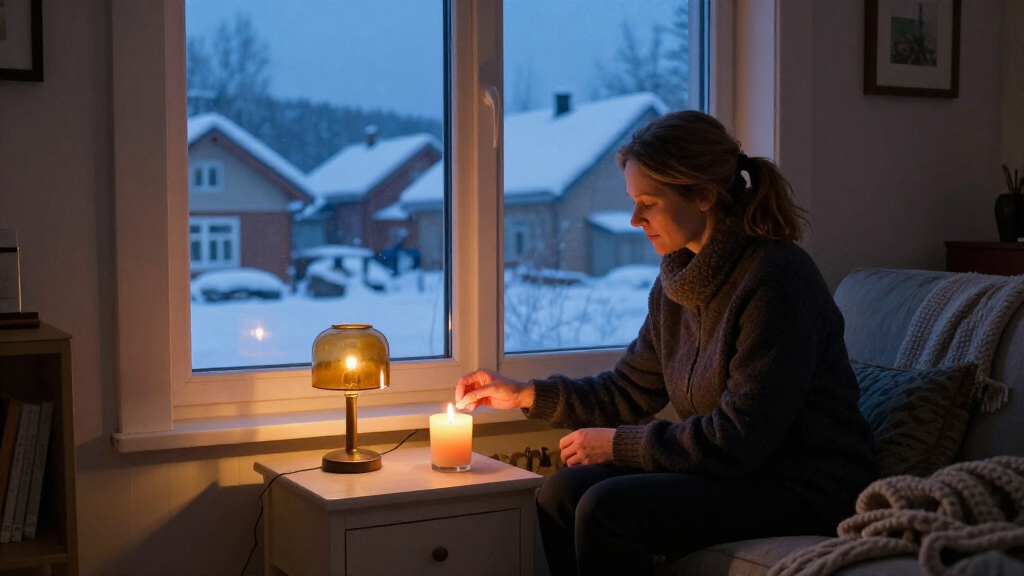
Simonsen also discusses light as part of how a home is experienced. She says a warmly lit window can suggest that someone is home, describing lighting as a consideration for occupants and visitors as well as a technical feature.
As an affiliate, we earn on qualifying purchases.
Designing for Nordic Seasonal Light
Livingetc’s report places the advice against Norway’s seasonal daylight changes. It says December daylight can reach a maximum of six hours a day in parts of the country and fall to none in its northernmost areas. The source does not specify a particular location or measurement method for those figures, so they describe the report’s broad comparison rather than a detailed daylight forecast.
Simonsen, who is based in Stavanger, says climate, geography and the people living in a home inform her design work. The report also describes her interest in traditional Norwegian architecture. She says seasonal change should be considered in the design of a home and its lighting.
“I don’t think we can design homes as though light remains constant throughout the year. Nor do I think the answer is to fight the darkness.”
— Gudbjørg Simonsen, Norwegian designer, quoted by Livingetc
As an affiliate, we earn on qualifying purchases.
Limits of the Published Advice
The source presents an interior designer’s perspective, not a controlled study comparing lighting designs or measuring their effects on health, sleep or mood. It does not provide specific product recommendations, brightness levels, color temperatures or room-by-room plans. The supplied report also ends partway through its discussion of layered lighting, so further recommendations from the original article are not established by the material provided here.
The daylight figures are presented generally, without a named Norwegian city, exact dates or a cited data source. Conditions vary by location, and the report does not give enough detail to apply the maximum or zero-hour figures to every Norwegian household.
As an affiliate, we earn on qualifying purchases.
Applying the Advice at Home
For readers planning winter lighting, Simonsen’s reported guidance identifies areas to consider: which need focused light for tasks, where softer lighting may be appropriate, and whether each corner needs equal brightness. Choices can reflect the room’s use and the needs of its occupants.
Livingetc’s report does not announce a new product, policy or scheduled follow-up. It offers design guidance for homeowners reviewing how they use each space, including whether to combine task, ambient and accent lighting.
As an affiliate, we earn on qualifying purchases.
Key Questions
What is Gudbjørg Simonsen’s main winter-lighting advice?
She recommends designing for seasonal changes and using lighting for both practical visibility and atmosphere, rather than relying on uniform brightness.
Why does Simonsen recommend varied lighting?
She says variation, including brighter areas and shadow, reflects how light behaves in nature and can give a room more depth than even illumination.
What does layered lighting mean in this report?
It means using different kinds of light for different purposes, such as focused light for work, lighting to guide movement, and softer or decorative light to shape a room’s atmosphere.
Does the report establish that this lighting approach improves health?
No. The source reports a designer’s recommendations and does not provide research showing that a particular lighting scheme treats seasonal mood changes or improves health.
Source: rss
Halloween Picks
halloween
As an affiliate, we earn on qualifying purchases.