
TL;DR

Get decor and gifts delivered free with Prime
- Fast, free delivery on millions of items
- Prime Video, Amazon Music and more included
- Member-only deals all year
A framing-lumber stamp carries information that a price tag and visual inspection cannot: its grade, species, mill, grading agency and, in some cases, moisture condition. Those details connect a board to published structural design values and span tables, though a stamp does not guarantee every individual piece is on grade.
A lumber stamp on framing boards identifies the mill, grading agency, grade and species, and can show how wet the wood was when surfaced. A Family Handyman report explains why those markings matter: a board’s grade and species connect it to published strength ratings used in building-code span tables, information a price tag or quick visual check does not provide.
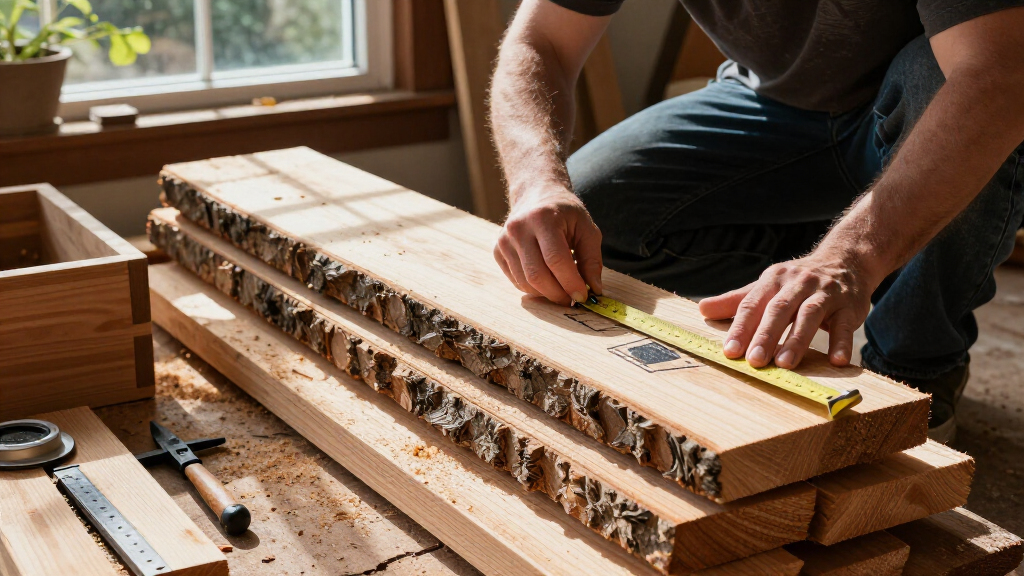
The stamp is generally printed in black ink near one end of dimensional framing lumber such as 2×4s and 2×6s. Its fields identify the mill that produced the board, the agency that supervised grading, the board’s grade and species, and sometimes its moisture condition at surfacing. The exact layout can vary by agency.
Grade describes the limits for defects such as knots, splits and holes that can affect a board’s strength. Combined with species, the grade keys to published design values, which are used in span tables to set how far a joist or rafter of a given size and spacing may extend between supports. The stamp is not a substitute for checking the appropriate span table or following building requirements.
The report says the 2024 International Residential Code requires sawn lumber used for load-supporting floor, wall and roof framing to carry a grade stamp or a certificate of inspection. It also notes that an accredited grading agency supervises grading at mills; the grader may be a mill employee, but the agency is required to inspect each mill at least 12 times a year, according to the source material.
How the Stamp Informs Structural Choices
For people buying lumber for framing, the stamp provides a link between the board in the rack and the structural assumptions behind code span tables. Two boards can look similar—or come from the same store—yet carry different grades, which permit different kinds or amounts of defects. Choosing solely by appearance can miss that distinction.
The markings also help buyers avoid treating every 2×4 as interchangeable. The source report describes a lumber grader who watched a buyer reject five boards for wane, or missing wood along an edge, then choose five replacements that were all below grade. The anecdote illustrates a practical point, not a measurement of how often shoppers make that mistake: visual preference does not establish a board’s structural grade.
For a project that carries loads, a buyer should match the lumber’s species and grade to the project’s design and applicable code requirements. A stamp helps identify what the board is rated as; it does not determine whether that rating is suitable for every use or replace professional design advice where required.
As an affiliate, we earn on qualifying purchases.
The Standards Behind the Ink
The report describes grading as a system governed by National Lumber Grading Rules and overseen by agencies accredited by the American Lumber Standard Committee, or ALSC. The federal standard cited is PS 20. ALSC accredits agencies that supervise grading, while the rules for dimension lumber are required to conform to a common national standard. The report says this is why a No. 2 grade has the same meaning across accredited agency marks.
The agency logo is separate from the mill identifier: it indicates who supervised grading, not who made the board. The source lists agencies commonly associated with different species and regions, including WWPA for Western species, SPIB for Southern Pine and NeLMA for some Northeastern species. Canadian mills may use Canadian agency marks under National Lumber Grades Authority rules.
Grades are not a promise that every board in a retail bin will meet the printed grade. ALSC executive vice president Paul Conway wrote that agencies check grading by production units, and a unit is considered on grade when at least 95 percent of its pieces make the grade. The report also cites the USDA Forest Products Laboratory’s Wood Handbook: published bending values are based on strength near the lower end of a grade and then divided by 2.1 for safety and long-term loading.
“I don’t think that they fully understand what it is they’re buying.”
— Pete Austin, director of quality at the Western Wood Products Association, as quoted by Family Handyman
As an affiliate, we earn on qualifying purchases.
What a Stamp Cannot Confirm
A stamp identifies the board’s assigned grade and related information, but it does not guarantee that every individual piece in a bundle or store bin is on grade. The report says agency checks are conducted by production unit, with a unit meeting the standard when at least 95 percent of its pieces qualify. It does not state how often a particular retailer’s stock contains boards that fall short.
The source material also does not provide a full explanation of every possible grade, stamp notation or moisture marking, nor does it establish that any specific board shown in the report was unsuitable for a particular project. Buyers still need to confirm that the grade, species, dimensions and condition match the intended use. A logo that a buyer cannot identify should be checked against the ALSC’s published list of accredited agencies, the report advises.
As an affiliate, we earn on qualifying purchases.
Check the Stamp Before Building
For a load-supporting project, the next step is to read the stamp and compare the species and grade with the project’s plans and applicable span tables. If the mark is unfamiliar, verify the grading agency rather than assuming that any printed logo represents an accredited grade. The report says ALSC publishes a list of U.S. and Canadian grading agencies and examples of their marks.
Homeowners should follow local code requirements and project specifications, and seek advice from a qualified building professional when a board’s rating or its suitability is uncertain. The report does not announce a change to lumber rules; it is a guide to interpreting markings already used on framing lumber.
As an affiliate, we earn on qualifying purchases.
Key Questions
What information does a lumber stamp provide?
A framing-lumber stamp generally identifies the mill, grading agency, grade and species. Some stamps also state the wood’s moisture condition when it was surfaced. Agency layouts differ.
Why does the grade matter?
Grade sets the kinds and limits of defects allowed in a board. Together with species, it links the lumber to published design values used in span tables for structural applications.
Does a grade stamp guarantee every board is on grade?
No. The report, citing ALSC executive vice president Paul Conway, says grading agencies assess production units and that a unit is on grade when 95 percent or more of its pieces qualify. The stamp does not guarantee every individual board in a retail bin.
What should I do if I do not recognize the agency logo?
Check the mark against the ALSC list of accredited grading agencies, which the report says includes examples of agency stamps. Do not assume an unfamiliar logo is an accredited grade mark.
Can I choose framing lumber by appearance alone?
Appearance can reveal visible defects, but it does not tell you the board’s assigned structural grade. For load-supporting uses, check the stamp and project requirements, and consult a qualified professional if the rating or application is unclear.
Source: rss
Fall Picks
fall essentials
As an affiliate, we earn on qualifying purchases.