
TL;DR
Listen free for 30 days with Audible
Thousands of audiobooks and originals — cancel anytime.
Start your free trialAs an affiliate, we earn on qualifying purchases.
Teaching a child to tell time involves introducing clock parts, understanding hours and minutes, and daily practice. Using visual aids and interactive tools makes the process fun and memorable. Consistency and patience are key to success.
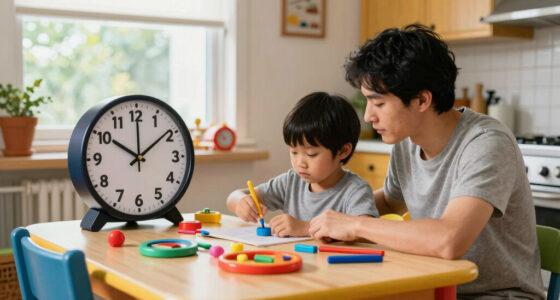
Imagine a child glancing at a clock and confidently saying, “It’s quarter past three!” That moment of understanding is priceless. Teaching kids to tell time isn’t about memorizing numbers; it’s about helping them see how the clock works like a little mechanical story, with each hand playing a role. This step-by-step plan makes that story easy to tell, turning a confusing puzzle into a clear, fun adventure.
You’ll learn how to introduce clock parts, teach hours and minutes, and practice in ways that stick. Whether you’re a parent, teacher, or caregiver, these practical tips will make teaching time natural and enjoyable for your child.
Start with the clock’s parts—make it tactile and colorful.
Teach the hour (o’clock) times first, then the minutes and special phrases like ‘quarter past.’
Use real clocks and daily routines for practical, hands-on practice.
Transition smoothly to digital clocks and 12-hour/24-hour formats.
Be patient: mastery can take weeks but becomes second nature with regular practice.
Start by showing your child the clock and its parts
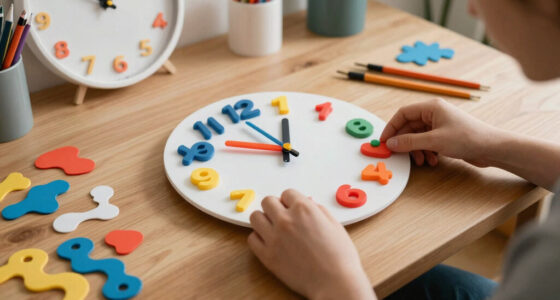
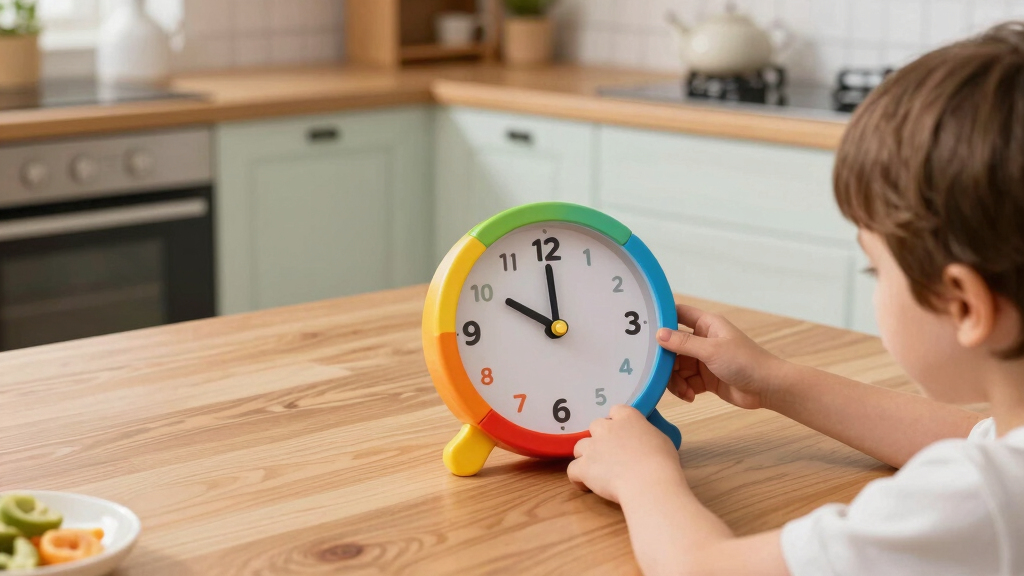
The first step is to familiarize them with the clock face. Point out the numbers 1 through 12 arranged in a circle, like a pizza slice. Then, introduce the hour hand—the shorter hand—and the minute hand, which is longer and points to the minutes. Real-world example: Place a colorful, movable clock on the table. Let your child rotate the hands and see how they move together.
This tactile experience helps them connect the visual layout with the physical movement, laying a solid foundation for understanding.

Learning Resources Big Time Mini Clock
- Hands-on learning clock: Teaches early time skills
- Hidden gears: Maintain correct time when spinning
- Color-coded hands: Match hour and minute markings
As an affiliate, we earn on qualifying purchases.
As an affiliate, we earn on qualifying purchases.
Teach the hour hand and ‘o’clock’ times first
Start with the simplest concept: telling the hour. When the hour hand points exactly at a number, the time is on the hour, like 3:00. Example: Set the clock to 4:00, and say, “The hour hand is on 4 — it’s four o’clock.” Practice by asking, “Where’s the hour hand now?” and encouraging them to identify the hour.
Understanding this foundational step is crucial because it establishes the basic rhythm of telling time. Recognizing when the hour changes helps children develop an intuitive sense of how hours progress throughout the day, which is essential for planning and daily routines. It also avoids confusion caused by partial or approximate readings, ensuring a clear mental model of the clock’s structure.
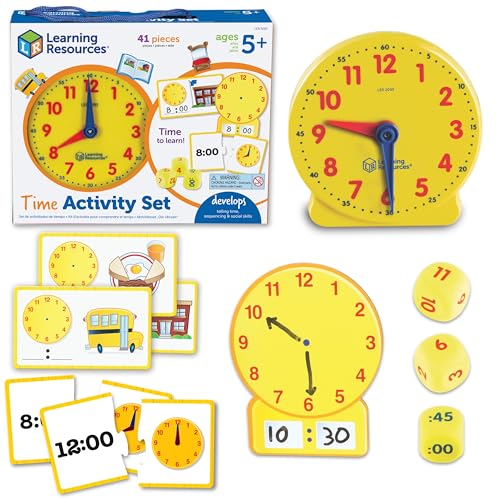
Learning Resources Time Activity Set
- Hands-On Time Learning: Realistic analog clock with moving hands
- Build Time-Telling Skills: Helps identify hours and half-hours
- Ideal for Students & Classrooms: Supports independent and guided learning
As an affiliate, we earn on qualifying purchases.
As an affiliate, we earn on qualifying purchases.
Show how the minute hand tells minutes past the hour
The minute hand points to the minutes, marked in 5-minute increments around the clock. Explain that each number the minute hand points to equals a multiple of 5 — 1 is 5 minutes, 2 is 10 minutes, and so on. Example: When the minute hand points to 3, it’s 15 minutes past the hour, or quarter past.
Understanding this relationship is vital because it transforms the minute hand from a simple pointer into a meaningful measure of time passage. This helps children grasp the concept of elapsed time within an hour, which is essential for estimating durations, understanding schedules, and developing time management skills. Recognizing the significance of these increments also prepares them for more complex time concepts, such as elapsed time calculations and time intervals.

Interactive Educational Teaching Clock – Learn Time Easily, Durable Design for Kids with moveable arms, Engaging Hands-On Learning Tool, Perfect for Classroom & Home Use
- Interactive Learning Clock: Movable hour and minute hands for teaching time
- Practice Cards Included: 30 double-sided exercises for skill reinforcement
- Montessori-Inspired Toy: Promotes problem-solving and motor skills
As an affiliate, we earn on qualifying purchases.
As an affiliate, we earn on qualifying purchases.
Frequently Asked Questions
When is the right age to start teaching my child to tell time?
Most children are ready between ages 5 and 7, but it depends on their interest and development. Watch for signs they can understand basic concepts of numbers and can focus for short periods.
What are the best tools to help teach time?
Colorful, movable clocks, interactive apps, printable worksheets, and real-life practice during routines make learning engaging and effective.
How do I make learning to tell time fun?
Turn it into games or puzzles, incorporate storytelling, and include time-telling as part of daily activities like cooking or planning outings.
What if my child struggles with understanding the clock?
Break lessons into small steps, use plenty of visual aids, and practice regularly. Patience and encouragement go a long way.
Learning Resources Big Time Mini Clock
- Hands-on learning clock: Teaches early time skills
- Hidden gears: Maintain correct time when spinning
- Color-coded hands: Match hour and minute markings
As an affiliate, we earn on qualifying purchases.
As an affiliate, we earn on qualifying purchases.
Conclusion
Teaching a child to tell time is about making the clock a story they understand. Small steps, plenty of hands-on experience, and daily practice transform confusion into confidence. Remember, patience fuels progress — each moment they learn is a step toward independence.
Imagine a future where they glance at a clock and know exactly what time it is, without hesitation. That’s the real gift of this skill — opening a window to the world’s schedule, one clock hand at a time.
Labor Day sales Picks
labor day deals
As an affiliate, we earn on qualifying purchases.