TL;DR

Get decor and gifts delivered free with Prime
- Fast, free delivery on millions of items
- Prime Video, Amazon Music and more included
- Member-only deals all year
Word clocks display time with words, but their letter grids vary widely across languages. These differences stem from vocabulary, grammar, and cultural nuances, leading to diverse, innovative designs.
Imagine a clock that spells out the time in your language—no numbers, just words floating across a sleek, illuminated grid. That’s the magic of a word clock. But what happens when you switch languages? The letter grid shifts, adapts, and reshapes itself to fit the vocabulary and grammar of each tongue.
In this guide, you’ll see how languages influence the design of these clever timepieces. We’ll explore how the letter grids change, the challenges designers face, and the innovations that make multilingual clocks possible. Ready to see how words tell time across different cultures? Let’s dive in.
Language structure directly impacts how the letter grid of a word clock is arranged, influencing design complexity and clarity.
Multilingual clocks require adaptable grids or multiple layouts, which can be achieved with modern programmable technology.
Languages with longer words or complex grammar challenge designers to innovate with modular or dynamic grid solutions.
Comparison tables reveal key differences in size, vocabulary, and challenges across languages, guiding better design choices.
Creating a multilingual word clock involves careful mapping, testing, and cultural awareness to ensure readability and aesthetic appeal.
Word Clocks in Different Languages: How the Letter Grid Changes
Word clocks display time with illuminated words instead of numbers. Switch the language, though, and the whole matrix has to adapt: vocabulary length, grammar, syntax, regional phrasing, and cultural expectations all reshape the grid.
Compact layouts can hide “IT IS FIVE PAST TEN” inside a fixed letter matrix.
Longer phrases demand larger grids, smaller type, or smarter placement.
Language is not a skin for the clock. It is the architecture of the grid.
Key InsightTime appears as highlighted text, not digits.
Sentence order changes where words must sit.
Programmable clocks can switch language layouts.
Every minute phrase needs readability checks.
Translation is the easy part. Layout is the real puzzle.
English, German, French, Finnish, and other languages use different word lengths, sentence structures, and time expressions. A good word clock balances clarity, elegance, manufacturing limits, and cultural fluency.
Word Length Sets the Footprint
Short words like “IT” and “IS” are simple to place. Longer terms such as “QUARTER,” “MINUIT,” or compound forms can force wider grids or denser typography.
Syntax Changes the Reading Path
Some languages say minutes before the hour, some after. Others use different structures around halves and quarters, changing the order of illuminated words.
Natural Phrasing Matters
A clock must sound right to native speakers. Formality, regional variants, abbreviations, and local time-telling habits shape the final vocabulary list.
Same time, different matrix.
Each language brings its own spatial pressure. Designers usually begin with a vocabulary inventory, then map the words into rows that remain readable when LEDs light up.
| Language | Common Words | Grid Pressure | Design Challenge | Multilingual Fit |
|---|---|---|---|---|
| English | IT, IS, FIVE, TEN, PAST, TO, HALF | Moderate | Balancing repeated minute words with hour names | ✓ Strong baseline layout |
| German | ES, IST, FUENF, ZEHN, HALB, UHR | High | Longer compounds and regional phrasing variants | ~ Needs careful phrase mapping |
| French | IL, EST, CINQ, DIX, ET, MOINS, MINUIT | High | Positioning longer words and midnight/noon terms | ~ Good with expanded grid |
| Finnish | Longer inflected forms and case endings | Very High | Grammar can multiply required word forms | ✗ Hard without dynamic layouts |
How a multilingual word clock gets built.
Programmable LEDs, microcontrollers, and layout algorithms make multilingual clocks practical, but the process still starts with language research and ends with real-world readability testing.
List Words
Collect every phrase needed for five-minute increments, hours, noon, and midnight.
Map Grammar
Document word order, regional variants, and formal or informal expressions.
Pack Grid
Place words in a fixed matrix or generate separate layouts for each language.
Program LEDs
Use Arduino, Raspberry Pi, or custom firmware to illuminate the correct words.
Test Clarity
Check every time phrase for readability, rhythm, spacing, and cultural fit.
What makes one language harder than another?
The hardest layouts usually combine long words, many grammatical variants, and strict readability demands. Flexible software helps, but the grid still has physical limits.
Static Grid to Dynamic Grid
A clock face is a hidden text system.
Only a few letters glow at once, but every unused letter still helps disguise the vocabulary. The art is making the inactive grid feel intentional rather than random.
Key Takeaway
Language structure directly impacts the letter grid. Multilingual clocks work best when the hardware can support either adaptable grids or multiple stored layouts.
Longer words and complex grammar are not just translation issues. They affect font size, row count, LED density, power use, and manufacturing cost.
From spoken time to illuminated design.
A reliable multilingual clock connects linguistic research to physical display choices. Each decision traces forward into the final grid.
How do I choose the right size?
List every word needed in each language, then choose a grid that fits the longest words comfortably. Larger grids add flexibility but use more space and power.
Can more languages be added later?
Yes, when the clock has programmable firmware or modular layouts. The grid must still accommodate the new vocabulary without becoming cluttered.
What tools help design the grid?
Python scripts, layout algorithms, Arduino IDE workflows, and open-source templates can generate and test language-specific word placements.
What cultural details matter?
Regional phrasing, accents, abbreviations, and formal versus informal expressions can all affect whether the clock feels natural to native speakers.
How Language Shapes the Letter Grid of a Word Clock
Word clocks in different languages don’t just translate words—they reshape the entire letter grid. Each language’s unique vocabulary, grammar, and syntax demand a tailored layout. For example, in English, common words like “IT”, “IS”, “FIVE”, and “TEN” fit neatly into a grid. But in German, you need to accommodate longer words like “ES” or “IST”, and for French, words like “IL” and “EST” take different positions.
Understanding why these differences matter is crucial for effective design. The length and structure of words influence readability and aesthetic balance. Longer words may require larger fonts or more space, which can complicate the grid layout and increase manufacturing costs. Shorter words, while easier to fit, might limit the expressiveness or clarity of the display. This tradeoff impacts the overall user experience—balancing clarity, elegance, and functionality is key. Designers must also consider how often certain words are used; prioritizing frequently used terms ensures the clock communicates time efficiently and intuitively.
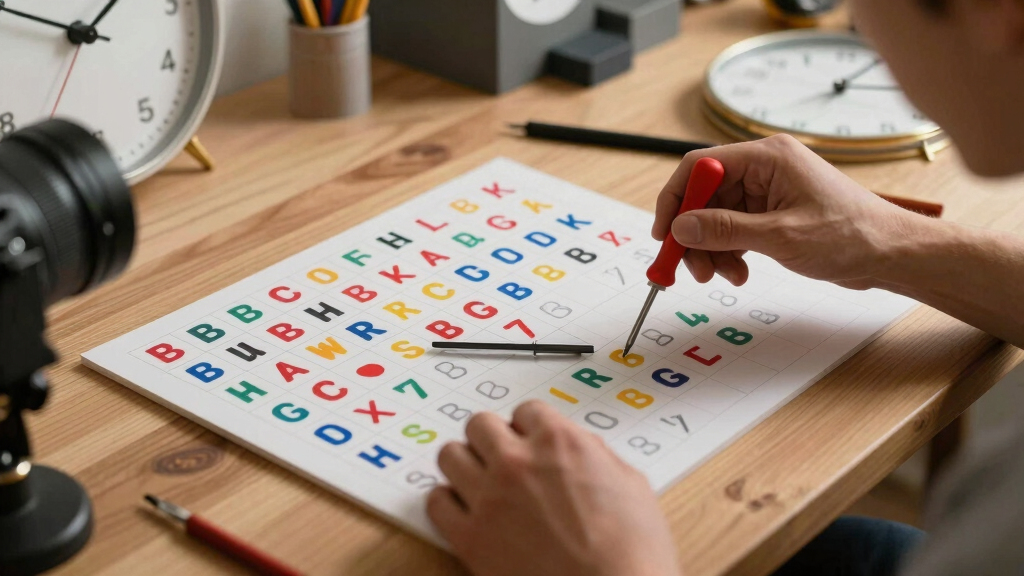
Take a look at a typical English word clock. It might have a 10×11 letter grid where “IT IS” appears at the top, with options for “FIVE” and “TEN” spread out around. In German, the grid must include “ES” and “IST”, which are shorter but need to be placed for clarity. French clocks, meanwhile, often include “IL” and “EST”, requiring different positioning and sometimes longer words like “MINUIT” for midnight.
Designers must balance these differences, fitting all necessary words into a fixed matrix. The result? A grid that looks different across languages but functions equally well—telling time vividly in each tongue. Recognizing these nuances helps designers optimize layouts that are both practical and aesthetically pleasing, ensuring multilingual clocks are accessible and intuitive for users worldwide.
As an affiliate, we earn on qualifying purchases.
Multilingual Word Clocks: How They Juggle Several Languages
Multilingual clocks act as linguistic bridges, allowing users to switch seamlessly between languages—this flexibility is not just a convenience but a reflection of cultural adaptability. The core challenge lies in designing a system that can dynamically accommodate different vocabularies, grammar rules, and sentence structures without sacrificing readability or aesthetic appeal. This requires a deep understanding of linguistic diversity and the implications it has on visual design.
For instance, some languages may have longer words or more complex grammatical structures, which influence how much space each word needs and how the grid is arranged. When designing these clocks, creators often use adaptable software that can generate optimized layouts for each language, considering factors like word length, common phrases, and grammatical requirements. This allows the clock to maintain clarity and aesthetic integrity across multiple languages, but it also introduces tradeoffs—such as increased complexity and cost.
Beyond technical challenges, cultural considerations are vital. Certain languages might prefer formal or informal expressions, or have regional variations that influence word choice. Designers must be sensitive to these nuances to ensure the clock feels natural and respectful in each language context. Moreover, the ability to add or update languages later depends on the flexibility of the hardware and software architecture—scalability is key for longevity and user satisfaction.
By understanding and planning for these linguistic and cultural factors, designers can create multilingual clocks that are not only functional but also culturally resonant. This approach extends the clock’s relevance and appeal, making it a truly global device that celebrates linguistic diversity while telling time with elegance and clarity.
As an affiliate, we earn on qualifying purchases.
Frequently Asked Questions
How do I choose the right size for a multilingual word clock?
Start by listing all the words needed in each language. Pick a grid size that can comfortably fit the longest words without clutter. Larger grids offer more flexibility but require more space and power—balance is key.Can I add more languages later to my existing word clock?
Yes, if your clock has a programmable interface or modular design, you can update or expand its language options. Just ensure the grid can accommodate additional words or switch between layouts smoothly.What software tools help in designing the letter grids?
Tools like Python scripts, custom algorithms, or microcontroller programming environments (e.g., Arduino IDE) help generate dynamic layouts. Some open-source projects also offer templates to adapt for different languages.Are there any cultural considerations to keep in mind when designing a multilingual clock?
Absolutely. Be aware of regional language variations, accents, and formal vs. informal expressions. Respect cultural preferences for how time is expressed—and consider how symbols or abbreviations might vary.LED word clock with language options
As an affiliate, we earn on qualifying purchases.
As an affiliate, we earn on qualifying purchases.
Conclusion
Word clocks beautifully illustrate how language shapes visual design. Whether in English, German, or Finnish, each language’s unique structure demands creative solutions that blend linguistics and technology.
Thinking about building your own? Focus on flexibility and cultural nuances—your clock will tell stories as much as it tells time. After all, words are powerful, and in a clock, they become art that speaks every language.
As an affiliate, we earn on qualifying purchases.
Halloween Picks
halloween
As an affiliate, we earn on qualifying purchases.