
TL;DR

Get decor and gifts delivered free with Prime
- Fast, free delivery on millions of items
- Prime Video, Amazon Music and more included
- Member-only deals all year
A Veranda report shares dressing-room lighting recommendations from interior designers Kate Marker and Jessica Kain Barton. They suggest combining overhead fixtures with task lighting, using warm bulbs for general lighting and installing dimmers for decorative fixtures.
A Veranda report on dressing room design summarizes recommendations from interior designers Kate Marker and Jessica Kain Barton. They advise combining overhead and task lighting rather than relying on a single ceiling source. Their suggestions include warm 2700K bulbs for general lighting, sconces near mirrors to reduce facial shadows, and dimmers for decorative fixtures.
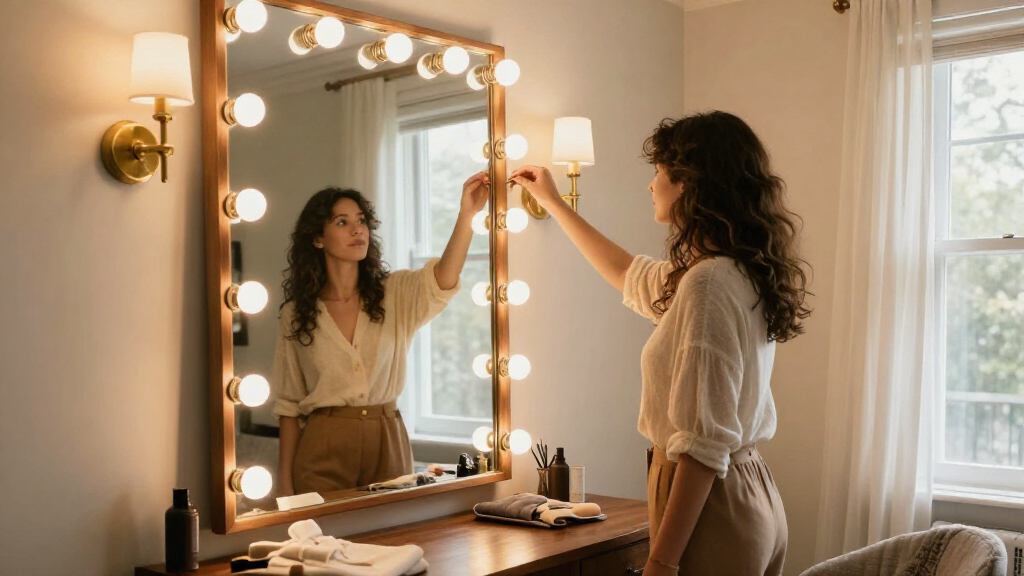
Marker recommends layering lighting in a dressing room. A decorative pendant or small chandelier can provide overhead light, while wall sconces beside a mirror add light closer to face level. Marker says this placement can help minimize shadows when someone is getting ready. For a vanity set into a closet, Barton suggests small library sconces mounted from cabinetry or paneling.
The designers also caution against depending only on recessed lights. Marker says recessed lighting can feel harsh and cast shadows. If it is needed, Barton recommends keeping the number to four or fewer and choosing fixtures no wider than three inches; she favors mud-in styles that sit discreetly in the ceiling. She also suggests an overhead chandelier, lantern or flush mount with at least three or four candle bulbs.
For most dressing room lighting, both designers favor 2700K bulbs, which produce a warmer glow. Marker recommends 3000K bulbs with excellent color rendering at a vanity, where seeing colors clearly matters. She also advises putting decorative lights on dimmers so their brightness can be adjusted. The report presents these as design recommendations, not as a universal lighting standard.
Balancing Mirror Light and Ambience
Dressing rooms are used for tasks such as choosing clothes, applying makeup and selecting jewelry. The designers say a single overhead source may not provide the lighting needed for all these activities. They recommend separating general illumination from face-level task light, while incorporating decorative fixtures into the room’s design.
Bulb temperature and fixture placement affect a room’s lighting, but the source does not establish that one setup suits every space. Room size, mirror position, available daylight and personal preferences may affect fixture choices. The recommendations offer options to consider when planning a room or consulting a lighting or interior design professional.
Products Worth Considering

EGO Power+ Cordless Pole Saw with LED Cut Line Indicator, 56V 2.5Ah Battery and Charger (PS1001)

EGO POWER+ LB7654 Cordless Leaf Blower with 5.0Ah Battery

Greenworks 24V 8-Tool Cordless Combo Kit with Power Bank Batteries and 65W Charger
As an affiliate, we earn on qualifying purchases.
From Private Boudoir to Dressing Room
The report briefly traces the dressing room’s history to antechambers used in English and European homes during the 17th century. These rooms offered privacy for dressing and personal activities. The article connects that history to modern dressing rooms and focuses on lighting choices for these spaces.
Marker is an interior designer who recently released a lighting collection with Mitzi of Hudson Valley Lighting Group at High Point’s fall market, according to the report. Barton is based in Louisville, Kentucky, and works through J. Kathryn Interiors. Their comments offer two designers’ perspectives; the source does not cite a formal study or industry-wide survey.
“My biggest must-do [when decorating a dressing room] is layering lighting. You want a combination of ambient and task lighting so the room feels warm and inviting but is still functional.”
— Kate Marker, interior designer
Room-Specific Choices Still Matter
The report does not give a lighting plan, fixture spacing or brightness target for a particular room. It also does not specify how the recommendations should change with ceiling height, room dimensions, daylight or the placement of wardrobes and mirrors. The suggested bulb temperatures and recessed-light limits are attributed to the designers and should not be read as building-code requirements or a substitute for a tailored plan.
The source does not provide independent testing comparing different bulb temperatures or fixture arrangements. It is also unclear what lighting conditions will best represent clothing colors for every reader; Marker’s recommendation for high color rendering at a vanity is general advice, not a named product specification.
Apply the Advice to Your Layout
When planning a dressing room, identify the areas and tasks that need light, including the full-length mirror, vanity, storage and general circulation. That layout can inform decisions about an overhead fixture, mirror-side sconces and any recessed lights. Readers can compare the designers’ suggestions—2700K for general lighting, 3000K with strong color rendering at a vanity, and dimmers for decorative fixtures—with the conditions in their rooms.
The report announces no follow-up project, product launch or further design guidance. It does not set a timeline for additional information; more detailed recommendations would depend on future reporting or advice tailored to an individual space.
Key Questions
What is the main lighting recommendation for a dressing room?
Interior designer Kate Marker recommends layering ambient and task lighting. In practice, that can mean a decorative ceiling fixture combined with mirror-side sconces or another suitable task light.
What bulb temperature do the designers recommend?
Marker and Jessica Kain Barton say they generally favor 2700K bulbs for a warm dressing room. Marker suggests 3000K bulbs with excellent color rendering for vanity lighting.
Are recessed lights unsuitable for dressing rooms?
The designers do not rule them out, but Marker says recessed lights can feel harsh and create shadows if used alone. Barton suggests limiting them to four or fewer, with a diameter of no more than three inches, when architectural lighting is needed.
Why place sconces beside a mirror?
Marker says face-level lighting can help minimize shadows while getting ready. Barton also recommends small sconces for a vanity built into cabinetry or paneling.
Should dressing room lights be on dimmers?
Marker recommends dimmers for decorative lighting so brightness can be adjusted. The source does not specify dimmer requirements for every fixture or room.
Source: veranda.com