
TL;DR

Get decor and gifts delivered free with Prime
- Fast, free delivery on millions of items
- Prime Video, Amazon Music and more included
- Member-only deals all year
Livingetc has published five Japanese-inspired kitchen storage lessons focused on reducing clutter, assigning containers clear functions and keeping frequently used items accessible. The advice comes from designer Yoko Kloeden and Nakagawa executive vice president Tasuku Ogino; it is practical guidance, not a formal study or a report of a new storage product.
Livingetc has published five Japanese-inspired kitchen storage lessons, advising readers to declutter before buying organizers, choose containers for specific jobs and keep only useful, attractive items on counters. The report draws on comments from London-based interior designer Yoko Kloeden and Tasuku Ogino, executive vice president of Japanese home-goods company Nakagawa.
The advice starts with reducing what needs to be stored. Kloeden says people should examine a shelf and decide what each item is for before adding storage. The report presents this as a way to avoid spending money on organizers that may simply make crowded cupboards harder to manage.
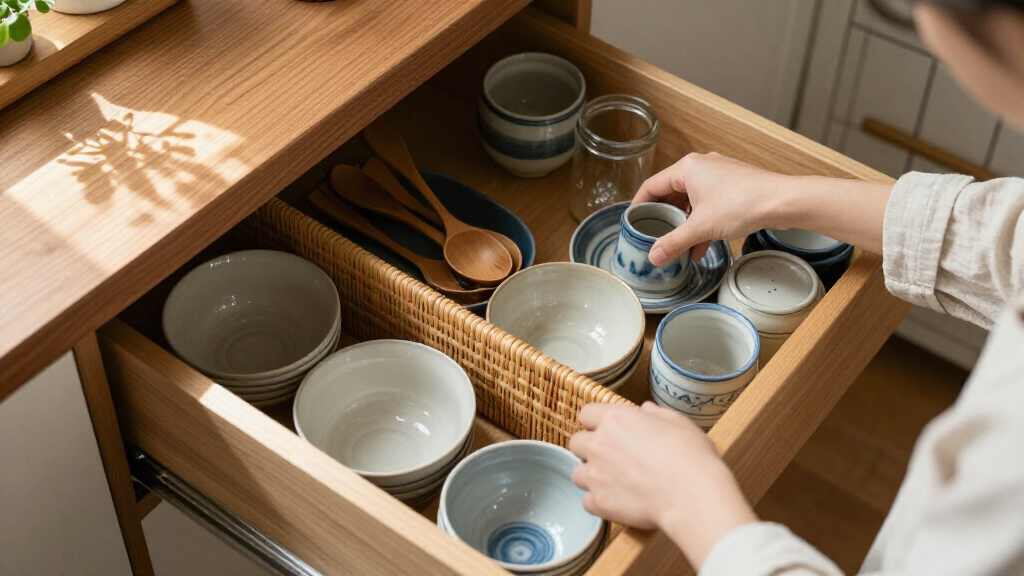
A second principle is to match the container to its contents and use. Kloeden describes using paulownia, or kiri, boxes for dried goods and tea, and ceramic jars for salt and sugar, which can clump in their original bags. She also says a container used repeatedly should have a lid that is easy to lift with one hand. Her examples are advice from a designer; the report does not provide independent testing of the materials or storage methods.
The remaining lessons focus on daily routines and reducing unnecessary handling. Keep frequently reached-for spices and utensils accessible; choose cookware that can move from cooking to serving; and leave counter space for items that are both used daily and visually suited to being on display. Kloeden cites a lidded rice pot that draws off steam and vessels that can store, reheat and serve food. Those examples illustrate the principles rather than establish that one product or material works for every kitchen.
Less Clutter, Fewer Extra Steps
The report’s practical value is its focus on how a kitchen is used, not just how it looks. Putting daily tools within reach can reduce interruptions while cooking, while cookware that also serves food may cut down on transfers and dishes. Keeping counters clear can also leave more room for preparation.
These ideas may help readers make better use of limited cabinet and counter space without immediately buying more equipment. Their usefulness will vary with household routines, kitchen layout and the items people own. The report offers design guidance, not measured evidence that the approach will save a particular amount of time, money or space.
Japanese style kitchen storage containers
As an affiliate, we earn on qualifying purchases.
As an affiliate, we earn on qualifying purchases.
Five Principles From the Report
The article frames its suggestions as lessons drawn from Japanese kitchen storage practices, with particular emphasis on purpose and restraint. Its five rules are to declutter before adding storage, give containers a defined job, make regularly used cooking items easy to reach, select cookware that can serve more than one role, and apply a two-part test to countertop objects: are they used daily, and do they look appropriate on display?
Kloeden connects the final rule to the Japanese phrase dashite totonou, which the report renders as “out, and in order.” Ogino describes the visual effect as merihari, or deliberate contrast. These terms are presented through the interviewees’ explanations; the article does not claim that every Japanese household follows the same approach.
“Before you add storage, take one shelf and ask what each thing on it is for.”
— Yoko Kloeden, interior designer
As an affiliate, we earn on qualifying purchases.
Advice, Not Comparative Testing
The supplied report gives no publication date, survey data or comparative testing, and it does not quantify how much space or time readers might save. Its material-specific examples, including paulownia boxes and ceramic vessels, are attributed to Kloeden rather than supported with independent performance evidence in the article.
It is also unclear how broadly the five principles reflect kitchens across Japan. The report presents them as useful lessons, not as rules followed by all Japanese households. Readers may need to adapt the suggestions to their own storage needs, cooking habits and available space.
lidded rice cooker with steam vent
As an affiliate, we earn on qualifying purchases.
As an affiliate, we earn on qualifying purchases.
Start With One Shelf
The report gives readers a straightforward first step: choose one shelf, identify the purpose of each item and remove what no longer earns its place before buying additional storage. From there, readers can group ingredients by use, move daily tools within reach and review which objects genuinely need to stay on the counter.
Livingetc’s supplied article also points readers toward its coverage of the Japanese 5S method for clearing clutter. No product launch, follow-up study or further development is announced in the source material.
kiri wood storage boxes for dried goods
As an affiliate, we earn on qualifying purchases.
As an affiliate, we earn on qualifying purchases.
Key Questions
What are the five Japanese-inspired kitchen storage lessons?
Declutter before buying storage, choose containers for specific contents, keep frequently used tools accessible, use cookware that can also serve food, and leave counters clear except for items used daily and suitable for display.
What does the report recommend doing before buying organizers?
Yoko Kloeden advises reviewing a shelf first and asking what each item is for. The idea is to reduce unnecessary belongings before adding more storage products.
Does the article prove that Japanese storage methods work better?
No. The source presents design advice and interviewee examples; it does not report comparative tests or evidence that the methods outperform other approaches.
What does “one object, many uses” mean for cookware?
Kloeden uses the phrase ichibutsu tayō for vessels that can serve more than one purpose, such as cookware that moves from cooking to the table or a container used to store and serve leftovers.
Source: rss
Halloween Picks
halloween
As an affiliate, we earn on qualifying purchases.