
TL;DR

Get decor and gifts delivered free with Prime
- Fast, free delivery on millions of items
- Prime Video, Amazon Music and more included
- Member-only deals all year
The cuckoo clock originated in 18th-century Germany’s Black Forest, evolving from early automata to the iconic chalet design. Today, it’s both a cherished craft and a modern decor statement, with authenticity still highly valued.
Few clocks are as instantly recognizable as the cuckoo clock. Its cheerful bird call and charming wooden figures evoke cozy mountain cabins and centuries-old craftsmanship. But behind that familiar face lies a story that stretches back nearly 300 years.
From its modest beginnings in a tiny German region to its status as a cultural icon, the cuckoo clock’s journey is full of surprises. You’ll learn how it was born, what makes its design special, and how modern versions keep the tradition alive—sometimes with a twist.
The cuckoo clock originated in the Black Forest of Germany in the early 1700s, not Switzerland as often believed.
Its iconic chalet design was established in the mid-19th century, becoming a symbol of regional craftsmanship.
Mechanically, cuckoo clocks use bellows and pipes for the bird call, driven by weights and gears—an art in precision and tradition.
Today, both authentic mechanical clocks and modern quartz versions thrive, blending heritage with contemporary style.
Certification like VdS helps ensure you buy genuine Black Forest craftsmanship, protecting tradition amid mass imports.
The History of the Cuckoo Clock
Nearly 300 years of mechanical birds, carved forests and precision timekeeping—from a winter cottage industry in Germany’s Black Forest to an enduring global design icon.
From Black Forest workshops to contemporary interiors.
Air passes through two pipes to make the paired call.
Traditional movements are wound daily or approximately weekly.
The railway-house form becomes the visual blueprint.
Born among the pines, not in the Alps
The cuckoo clock emerged in the Black Forest of southwestern Germany, where farming families made wooden clocks during long winters. The work combined useful timekeeping, local carving traditions and a European fascination with mechanical birds.
The cuckoo clock is not Swiss.
Orson Welles helped popularize the mistake in The Third Man in 1949. The historical tradition belongs to Germany’s Schwarzwald. Franz Anton Ketterer of Schönwald is often credited with an early cuckoo mechanism, but documentary evidence is thin: historians view the clock as a collective regional evolution.
Bird automata
Ctesibius creates water clocks with whistling birds, establishing an ancient link between time and mechanical song.
Cottage clocks
Black Forest farmers produce simple wooden clocks as a winter industry and sell them through regional markets.
The cuckoo emerges
Local makers refine bellows, pipes and moving bird figures into a recognizable clockmaking tradition.
A signature form
Eisenlohr’s railway-house design gives the cuckoo clock its enduring architectural identity.
Tradition remixed
Mechanical heirlooms coexist with minimalist, colorful and battery-powered interpretations.
How a railway building became the cuckoo clock
In 1850, architect Friedrich Eisenlohr submitted a gatekeeper’s house design to a competition associated with the Grand Duchy of Baden Clockmakers’ School. Its pitched roof and decorated façade became the basis of the celebrated Bahnhäusle style.
The chalet-like case gave buyers more than a clock: it offered a miniature story of mountain life and a recognizable piece of place.
Pitched roof
A strong triangular silhouette made the clock instantly recognizable from across a room.
Carved woodland
Leaves, animals, hunting motifs and dark-stained timber connected the object to the forest.
Animated life
Dancers, woodcutters and water wheels turned timekeeping into miniature theater.
Two-note call
Bellows, pipes and pendulum movements matured into a repeatable mechanical language.
A tiny theater powered by gravity
Traditional cuckoo clocks contain no recorded bird sound. Cast-iron pine-cone weights descend under gravity, driving the gears, the pendulum, the strike train and—on elaborate models—the animated scene.
Pulling the chains raises the weights. Their slow descent stores and releases the energy that keeps the clock alive.
Weights fall
Pine-cone weights supply gravitational energy.
Gears release
The movement regulates energy into precise intervals.
Bellows lift
Two bellows draw in and expel small pulses of air.
Bird performs
Pipes sound while the door, bird and figures move.
The anatomy of “cuck-oo”
| Feature | 1-day mechanical | 8-day mechanical | Quartz / battery |
|---|---|---|---|
| Traditional weights and chains | ✓ | ✓ | ✗ |
| Typical winding rhythm | Daily | About weekly | Battery changes |
| Air-driven bellows and pipes | ✓ | ✓ | ✗ |
| Collector preference | ~ Strong | ✓ Highest | ✗ Casual decor |
| Convenience | ✗ Frequent care | ~ Moderate | ✓ Easiest |
A clock that came to represent an entire region
Traveling peddlers carried Black Forest clocks throughout Europe and later to America. What began as supplemental farm income helped transform the region into a center of precision craft—and made the cuckoo clock shorthand for German ingenuity and Gemütlichkeit.
Farm to workshop
Seasonal cottage production expanded into specialized carving, movement making, assembly and export networks.
A forest in miniature
Each case could depict regional wildlife, folklore, occupations and domestic rituals in moving wood.
Tourism sustains craft
Triberg, Schonach and nearby towns preserve the tradition through museums, workshops, trails and giant clocks.
Look for certified Black Forest craftsmanship.
The VdS certification mark identifies genuine mechanical Black Forest cuckoo clocks. It helps distinguish regional craft from mass-produced imports and supports the workshops preserving the tradition.
How the icon evolved without losing its voice
The cuckoo clock’s survival rests on a connected chain: old fascination became local skill, local skill became recognizable design, and recognizable design became a heritage market flexible enough to accommodate new styles.
Its true birthplace is Germany’s Black Forest—not Switzerland.
The familiar chalet form took shape with Eisenlohr’s 1850 design.
Weights, gears, bellows and pipes create the traditional performance.
Mechanical heirlooms and contemporary quartz designs now coexist.
VdS certification helps protect authentic regional craftsmanship.
Frequently asked questions
Where was it invented?
In the Black Forest region of southwestern Germany during the early-to-mid 18th century.
Who invented it?
Franz Anton Ketterer is traditionally credited, but the evidence favors a collective evolution across regional workshops.
How does the bird call work?
Two small bellows push air through organ-like pipes, producing the clock’s familiar paired notes.
Are modern clocks still authentic?
Yes—when they use traditional mechanical movements and meet genuine Black Forest production standards, often verified by VdS certification.
How the Black Forest Gave Birth to the Cuckoo Clock
The cuckoo clock’s roots lie deep in the Black Forest (Schwarzwald), a lush, pine-scented region in southwestern Germany. It’s here, in the early 1700s, that regional craftsmen began experimenting with simple wooden clocks combined with automata—mechanical figures that move and sing.
The first reference often points to Franz Anton Ketterer of Schönwald, who, around the 1730s–1740s, added a tiny bellows and pipe system to mimic the cuckoo’s call. However, the true story is more of an evolution. Multiple local artisans contributed, refining the idea over decades.
Before the cuckoo clock appeared, automata with bird figures had already fascinated Europeans for centuries. The ancient Greek engineer Ctesibius built water clocks with whistling birds, and Renaissance clockmakers in Augsburg created intricate bird automata—traces of a long-standing fascination with mechanical birds.
By the late 17th century, Black Forest villagers began making simple wooden clocks to sell at markets—these early pieces set the stage for what would become the cuckoo clock’s signature style.
Understanding this origin is important because it highlights how regional innovation, combined with a desire for functional artistry, led to the creation of a clock that would transcend its practical purpose. The evolution from automata to the cuckoo clock reflects a broader trend in craftsmanship—merging art, entertainment, and utility—making it a symbol of cultural identity that has endured because of its blend of technical skill and storytelling.
authentic Black Forest cuckoo clock
As an affiliate, we earn on qualifying purchases.
As an affiliate, we earn on qualifying purchases.
The Big Design Breakthrough: The 1850 ‘Railway House’ Look
By the mid-1800s, the cuckoo clock’s shape and style crystalized into its iconic form. The “Bahnhäusle” — or “railway house” — style, resembling a tiny mountain chalet, was designed in 1850 by Friedrich Eisenlohr, a renowned architect. This design, with its pitched roof, carved wood, and tiny balcony, became the visual blueprint for countless clocks to come.
This era also saw standardization of key features: the two-note cuckoo call produced by bellows and pipes, the pendulum-driven movement, and decorative carvings of forest scenes or mountain life. These elements turned the cuckoo clock into a recognizable symbol of Black Forest craftsmanship.
Imagine a workshop in Triberg or Schonach, where artisans carved tiny figures—woodcutters, dancers, water wheels—each clock a miniature storybook of mountain life. The design’s popularity spread across Europe and eventually to America, thanks to itinerant peddlers.
Understanding this design evolution matters because it reveals how regional aesthetic ideals and technological advancements converged to produce a product that was both functional and highly marketable. The chalet style not only evoked a sense of place but also created a narrative that appealed to a broad audience seeking authenticity and charm. This standardization also made production more efficient, ensuring that the tradition could be scaled without sacrificing craftsmanship, which is crucial for its survival and global appeal.
As an affiliate, we earn on qualifying purchases.
Why the Cuckoo Clock Became a Cultural Icon
The cuckoo clock did more than tell time; it became a symbol of German ingenuity and coziness. During the 19th century, it helped transform the Black Forest from a humble farming region into a hub of precision craft. Peddlers carried these clocks across Europe, then shipped them to America, making them household staples.
Today, towns like Triberg celebrate this heritage with museums, cuckoo clock trails, and workshops. Tourists flock to see giant cuckoo clocks and learn about the tradition firsthand.
Understanding why the cuckoo clock became a cultural icon involves recognizing how it encapsulates regional identity and craftsmanship. It’s not just a decorative object but a storytelling device—each clock bearing elements of local folklore, environment, and artisanal pride. The widespread popularity and romanticized image of the cuckoo clock also reflect a broader cultural desire to preserve traditions amid modern industrialization. Its status as a symbol of regional authenticity makes it more than a timepiece; it’s a tangible link to a cultural heritage that continues to resonate globally.
mechanical cuckoo clock with bird call
As an affiliate, we earn on qualifying purchases.
As an affiliate, we earn on qualifying purchases.
Inside the Mechanics: How the Cuckoo Calls and Moves
Ever wonder how that tiny bird pops out and makes its unmistakable “cuck-oo”? It’s a clever system of bellows, pipes, and weights. The clock’s weights, often shaped like pine cones, drive the entire mechanism. As they descend, they power the timekeeping, the cuckoo call, and any animated figurines.
The cuckoo’s call comes from two small bellows pushing air through organ-like pipes. The sound mimics the real bird’s two-note call—simple but instantly recognizable. The clock’s automation also includes tiny dancers, water wheels, or woodcutters that move when the cuckoo calls, adding charm and whimsy.
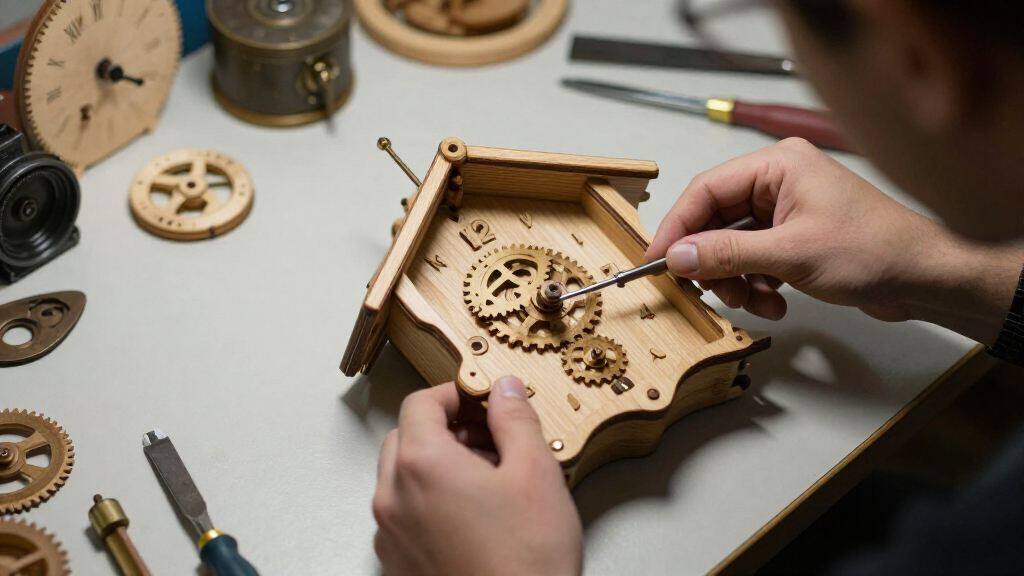
Old clocks require winding—pulling the weights back up to keep them running. Mechanical clocks run on either 1-day or 8-day movements, affecting how often you need to wind them. The intricate gears, carved from wood, are a testament to the craftsmanship of Black Forest artisans.
Understanding the mechanics deepens appreciation because it reveals the complex interplay between art and engineering. The precision required to synchronize the cuckoo’s call with animated movements reflects a high level of skill and patience, often passed down through generations. This craftsmanship creates a timeless quality that electronic reproductions struggle to replicate, underscoring the clock’s value as a cultural artifact and a piece of functional art.
As an affiliate, we earn on qualifying purchases.
Frequently Asked Questions
Where was the cuckoo clock actually invented?
The cuckoo clock was born in the Black Forest region of southwestern Germany in the early 18th century. It’s a product of regional craftsmanship, not Swiss origins as many believe.
Who invented the cuckoo clock?
While Franz Anton Ketterer is often credited with adding the cuckoo call around 1730, the clock evolved through regional workshops over decades. It’s more a collective regional invention than a single person’s creation.
How does the cuckoo call work?
The call is produced by two small bellows pushing air through organ-like pipes, mimicking the two-note call of the common cuckoo. It’s driven by the clock’s weights and gear system.
What’s the difference between 1-day and 8-day cuckoo clocks?
1-day clocks need winding every 24 hours, while 8-day clocks run for a week before needing a rewind. The longer duration often means more complex mechanisms and higher craftsmanship.
How can I tell if a cuckoo clock is authentic?
Look for the VdS certification mark, regional markings like ‘Made in Germany,’ and a mechanical movement. Authentic Black Forest clocks are handcrafted and often feature detailed carvings.
Conclusion
The cuckoo clock’s charm endures because it’s more than a timekeeper—it’s a story of regional pride, craftsmanship, and playful design. Whether you love its antique details or enjoy a sleek modern reinterpretation, it invites you to pause and smile every hour.
Next time you hear that cheerful cuckoo, remember: you’re hearing the echoes of centuries-old German ingenuity, still capturing imaginations today.
Fall Picks
fall essentials
As an affiliate, we earn on qualifying purchases.