
TL;DR

Get decor and gifts delivered free with Prime
- Fast, free delivery on millions of items
- Prime Video, Amazon Music and more included
- Member-only deals all year
Timekeeping has come a long way from ancient sundials to today’s smartwatches. This timeline highlights key innovations, technological leaps, and how each step changed our daily lives and society.
Imagine telling time by watching the sun’s shadow stretch across a stone slab. That’s how early humans kept track of hours—using simple tools that relied on the sky’s dance. Over thousands of years, these primitive devices blossomed into the sleek, digital marvels we wear today.
This journey isn’t just about gadgets; it’s about how each leap in technology reshaped our daily routines, navigation, and even our view of the universe. Ready to see how we went from sundials to smartwatches? Let’s dive into a vivid, lively timeline that reveals the story behind every tick and tock.
Ancient sundials relied on the sun’s position and had limited accuracy, but they were revolutionary for their time.
Mechanical clocks introduced in the Middle Ages provided more reliable time signals, shaping daily routines.
Quartz watches made personal timekeeping precise and accessible, starting in 1969.
Atomic clocks set the global standard for time, enabling GPS, internet sync, and scientific research.
Modern smartwatches blend accuracy with connectivity, transforming how we monitor health and stay informed.
Ancient Sundials: How Our Ancestors Used the Sun to Tell Time
Nearly 3,500 years ago, Egyptian priests carved the earliest sundials from stone, using a stick called a gnomon. As the sun moved across the sky, the shadow it cast on a marked surface told the time. These early devices depended on clear weather, but they were surprisingly accurate for their age—within about 15 minutes on a good day.
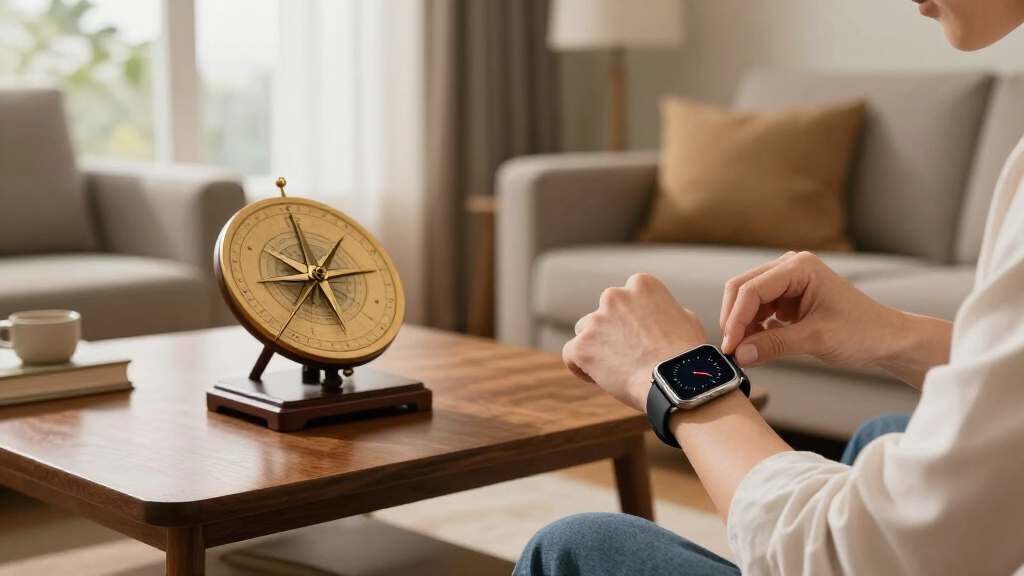
Think of a sundial as a silent, glowing compass pointing to the sun’s journey. It was the primary timekeeper for agricultural societies, helping farmers know when to plant or harvest. Yet, its biggest limitation? Seasonal changes and cloudy days made it unreliable.
Despite these limitations, sundials laid the groundwork for understanding the importance of consistent time measurement. They prompted societies to think about the regularity of the sun’s movement and inspired future innovations that would seek to overcome weather-dependent inaccuracies, ultimately leading to mechanical and atomic clocks.
digital smartwatches with health tracking
As an affiliate, we earn on qualifying purchases.
As an affiliate, we earn on qualifying purchases.
Mechanical Clocks: The Middle Ages’ Game-Changer
Fast forward to the 14th century. Mechanical clocks appeared in European monasteries, churning out consistent chimes from massive tower structures. These clocks used gears, weights, and escapements—like tiny engines—to keep time. They improved accuracy from hours to minutes, transforming daily life and work schedules.
Imagine the sound of a giant clock tower ringing out every hour, marking the rhythm of medieval towns. These clocks weren’t portable, but they laid the groundwork for future innovations—like the pendulum clock, invented in 1656, which cut errors from an hour to mere seconds.
Their significance extended beyond mere timekeeping; they became symbols of societal order and technological progress. By providing a reliable public time standard, they allowed for synchronized activities—markets, church services, and civic duties—fostering social cohesion and enabling more complex economic and administrative systems.
As an affiliate, we earn on qualifying purchases.
Quartz Watches: How 20th Century Tech Made Time Personal
The year 1969 marked a huge leap: Seiko unveiled the first quartz wristwatch. Powered by a tiny crystal that vibrates at a precise frequency, quartz watches offered unparalleled accuracy—losing only about 1 second every month. Suddenly, accurate time was affordable and compact, fitting comfortably on your wrist.
Picture the rich, dark aroma of fresh electronics filling a shop as these watches hit shelves. They transformed the watch from a luxury to a necessity, connecting millions to the precise rhythm of global time all day, every day.
This technological breakthrough democratized access to precise timekeeping, ensuring that not just the wealthy but everyone could rely on a device that kept time with remarkable accuracy. It also spurred a wave of innovation in consumer electronics, leading to further miniaturization, digital displays, and integration with other technologies—setting the stage for the connected world we live in today.
As an affiliate, we earn on qualifying purchases.
Atomic Clocks and the Digital Age: Achieving Perfect Precision
Atomic clocks, developed in the mid-20th century, use the vibrations of atoms—like cesium—to measure time with unmatched precision. These clocks define the standard for Coordinated Universal Time (UTC), making our GPS systems and internet synchronization perfectly reliable.
Imagine a clock so precise it would only lose a second in 100 million years. This extraordinary accuracy is crucial for modern technology, as it ensures that satellite navigation, telecommunications, and financial transactions happen seamlessly and without error. Without atomic clocks, the synchronization needed for global digital infrastructure would be impossible, highlighting their foundational role in our interconnected world.
Their development has also had profound scientific implications, enabling experiments that test the fundamental laws of physics and explore the universe’s deepest mysteries. As society increasingly depends on digital precision, atomic clocks serve as the invisible backbone that keeps our modern world ticking reliably.
As an affiliate, we earn on qualifying purchases.
From Wristwatches to Wearables: The Rise of Smart Timekeeping
The 21st century brought the smart revolution: smartwatches. These tiny computers on your wrist connect to your phone, monitor your health, and even send notifications. They build on quartz accuracy but add layers of connectivity and personalization.
Picture a sleek, black smartwatch gently buzzing in your pocket, displaying your heart rate or reminding you to stand. Today’s smartwatches aren’t just about telling time—they’re about living better, healthier, and more connected.
These devices have transformed timekeeping from a passive activity into an active, integral part of our daily lives. By integrating sensors that monitor sleep, activity, and even ECG data, smartwatches have become personal health hubs, offering real-time feedback and insights. This evolution signifies a shift from simple time-telling to comprehensive wellness management, reflecting society’s desire for convenience and health consciousness in a single, stylish device.
Key Innovations That Reshaped How We Keep Time
| Milestone | Year | Impact |
|---|---|---|
| Sundials | 1500 BCE | Basic shadow-based timekeeping, dependent on weather |
| Mechanical Clocks | 14th century | Consistent public time signals, helped shape daily routines |
| Quartz Watches | 1969 | Affordable, precise personal timekeeping |
| Atomic Clocks | Mid-20th century | Ultimate accuracy, basis for global time standards |
| Smartwatches | 2010s | Connected, multifunctional, health-focused devices |
What’s Next? The Future of Timekeeping in Your Pocket
The future promises even more precise atomic and quantum clocks, possibly integrated into everyday objects like glasses or clothing. Imagine a watch that adjusts itself to satellite signals instantly, or a device that predicts your schedule based on biological rhythms.
Think of your watch as a mini-scientist, constantly recalibrating itself with the universe’s most accurate clocks. As technology advances, our idea of time might become even more fluid, personalized, and seamless.
And perhaps, in the not-too-distant future, timekeeping will be so integrated into our lives that we won’t even think about it—just like breathing.
Your Practical Guide to the Timeline of Timekeeping
Here’s a quick rundown to remember:
- Ancient sundials used the sun’s shadow; accuracy was weather-dependent.
- Mechanical clocks in the Middle Ages set the stage for regular public time signals.
- The quartz watch of 1969 made personal, accurate time affordable.
- Atomic clocks in the mid-20th century became the gold standard for precision.
- Today, smartwatches combine accuracy with connectivity, transforming how we manage time and health.
Frequently Asked Questions
How accurate were ancient sundials compared to modern devices?
Ancient sundials could be accurate within about 15 minutes on clear days, but weather and seasons limited their reliability. Today’s atomic clocks are accurate to within a second in millions of years—showing just how far we’ve come.When did portable watches become a thing?
The first wristwatch appeared in the late 19th century, but it was in 1969 that quartz watches made small, accurate, affordable timepieces available to the masses. Now, digital and smartwatches are everywhere.Are smartwatches more precise than traditional clocks?
Smartwatches sync with atomic clocks via GPS or internet signals, so they achieve incredible accuracy—though atomic clocks are the ultimate standard, keeping time with almost unbelievable precision.What’s the most exciting future development in timekeeping?
Expect even more precise atomic and quantum clocks integrated into everyday objects, making timekeeping seamless and perhaps even predictive—like watches that adjust automatically to your biological rhythms.Conclusion
From shadowy silhouettes on stone to sleek digital screens, our way of measuring time reflects our relentless quest for precision and connection. Each step—whether a sundial or a smartwatch—tells a story of innovation and human ingenuity.
Next time you glance at your wrist, remember: you’re part of a centuries-long journey that keeps moving forward, ticking with every new discovery. Time waits for no one, but it sure has a fascinating history.
Columbus Day / Indigenous Peoples' Day Picks
long weekend sales
As an affiliate, we earn on qualifying purchases.